
Comprehensive Introduction to DLSS
DLSS (Deep Learning Super Sampling) and DLSS AI Technology – How It Works is an advanced AI-powered graphics technology developed by NVIDIA. It is designed to improve gaming performance while maintaining high image quality. DLSS uses artificial intelligence and machine learning to render games at a lower resolution and then upscale them to a higher resolution, giving smoother gameplay and better frame rates. Samsung Galaxy S26 & S26 Ultra 2026 Review
DLSS AI Technology – How It Works uses artificial intelligence to render at a lower resolution and then intelligently upscale the image to produce sharp, detailed visuals. This approach reduces the workload on the GPU while maintaining excellent graphics quality, making it especially useful for high-resolution gaming such as 1440p and 4K.
Technology Behind DLSS
The uniqueness of DLSS lies in its use of deep learning algorithms and dedicated AI hardware known as Tensor Cores inside RTX graphics cards. The system analyzes previous frames, motion data, and scene details to reconstruct high-quality images in real time.
Because of this intelligent processing, DLSS can enhance image clarity while simultaneously improving performance. It is not just a simple upscaling method; it is an AI-driven solution that continuously learns and improves through updates. F-15 Jet – The Fitter Jet

Performance Enhancement
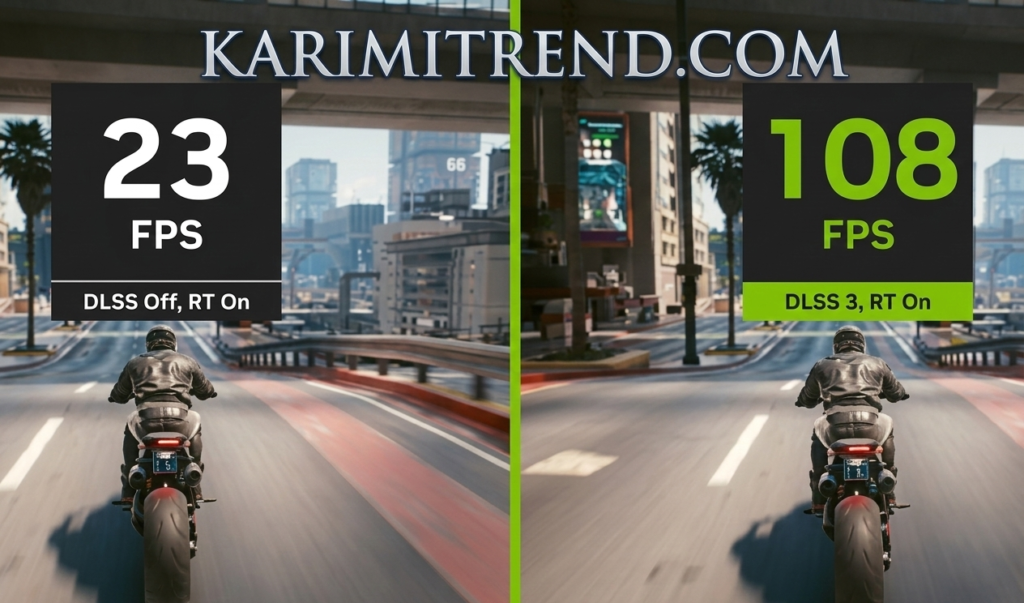
One of the biggest advantages of DLSS is its ability to significantly increase frame rates in demanding games. By reducing the rendering load on the GPU, DLSS allows smoother gameplay and better system efficiency. This is particularly beneficial in games that use advanced features such as ray tracing, which require high graphical power.
With DLSS enabled, players can enjoy higher graphics settings without experiencing performance drops, resulting in a more stable and responsive gaming experience.
Visual Quality Improvement
Despite rendering at a lower base resolution, DLSS maintains impressive image quality. Modern versions use advanced AI models that enhance textures, reduce blurring, and improve overall sharpness.
The technology ensures that details remain clear even during fast motion scenes. This balance between performance and quality is what makes DLSS one of the most important innovations in gaming graphics. Stryker Corporation Guide – Complete Blog
Role in Modern Gaming
DLSS has become a key feature in many modern PC games, especially those with high system requirements. It helps gamers achieve better performance on supported RTX GPUs while enjoying realistic lighting, shadows, and effects. As gaming technology continues to evolve, DLSS remains an essential tool that bridges the gap between powerful graphics and smooth gameplay.
DLSS has become one of the most important technologies in modern PC gaming, especially for high-resolution and ray-tracing games.
What is DLSS?
DLSS is a performance-enhancing technology that helps gamers get:
- ⚡ Higher frame rates
- 🎨 Better visual quality
- 🕹️ Smoother gameplay
- 💡 Improved ray tracing performance
Instead of rendering every frame at full resolution, DLSS uses AI to reconstruct high-quality images from lower-resolution inputs. This reduces GPU workload and increases performance.
How DLSS Works
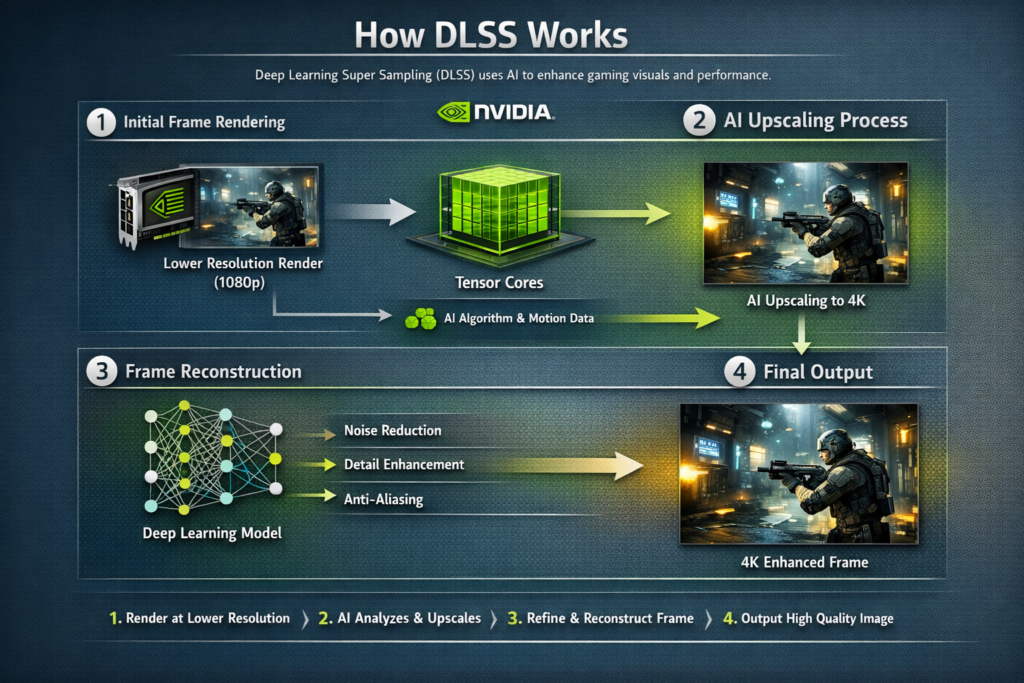
DLSS works using:
- Deep learning AI models
- NVIDIA Tensor Cores
- Frame reconstruction technology
DLSS (Deep Learning Super Sampling) is an AI-powered technology developed by NVIDIA. It improves gaming performance by using artificial intelligence to upscale lower-resolution images into high-quality visuals. Below is the complete step-by-step process of how DLSS works.
Step 1: Game Rendering at Lower Resolution
When DLSS is enabled, the game does not render the frame at full native resolution (like 4K). Instead, the GPU renders the game at a lower resolution, such as 1080p or 1440p. This reduces the workload on the graphics card and allows the system to generate frames faster. Because fewer pixels are processed, the frame rate (FPS) increases significantly at this stage.
Step 2: AI Analysis Using Tensor Cores
After the lower-resolution frame is created, it is sent to the AI processing unit inside the RTX GPU. NVIDIA’s Tensor Cores analyze the image using deep learning models. The AI studies motion data, previous frames, and game information to understand how the scene should look at a higher resolution. This intelligent analysis is what makes DLSS different from traditional upscaling methods. Step-by-Step Guide to Using the AEP Power Outage Map Effectively in 2026
Step 3: Frame Reconstruction
Using the trained AI model, DLSS reconstructs missing details in the image. It predicts textures, edges, lighting effects, and fine details that were not fully rendered in the lower resolution. This step improves sharpness, reduces noise, and enhances image quality. The AI continuously improves through updates and training.
Step 4: Upscaling to Target Resolution
Once the frame is reconstructed, DLSS upscales it to the desired output resolution, such as 4K. The result is a high-resolution image that looks close to native quality but requires much less GPU power. This process allows gamers to enjoy higher graphics settings without sacrificing performance.
Step 5: Final Output to Display
The enhanced frame is sent to the monitor for display. The user sees a smooth, high-quality image with improved frame rates. When combined with features like ray tracing, DLSS helps maintain stable performance while delivering realistic lighting and shadows. Stryker Corporation Guide – Complete Blog
Key Features of DLSS
1. AI Upscaling
Improves resolution without heavy GPU usage. One of the most important features of DLSS is AI-based upscaling. Instead of rendering a game at full resolution, DLSS renders it at a lower resolution and uses artificial intelligence to upscale it to a higher resolution.
This process maintains sharp image quality while significantly reducing the load on the GPU, resulting in smoother gameplay.
2. Higher FPS – DLSS AI Technology – How It Works
DLSS improves frame rates by reducing the number of pixels the GPU must process. Because the system renders fewer pixels initially, games run faster and more smoothly. This is especially useful for high-resolution gaming like 1440p and 4K.
3. Ray Tracing Support
Enhances performance when ray tracing is enabled. Ray tracing is a graphics feature that creates realistic lighting, shadows, and reflections, but it is very demanding on hardware. DLSS helps balance performance when ray tracing is enabled, allowing players to enjoy realistic visuals without major performance drops.
4. Image Quality Improvement
Maintains or improves visual clarity. Despite rendering at lower resolutions, DLSS maintains excellent visual quality. Advanced AI models reduce blurriness, improve texture detail, and enhance image sharpness. In many cases, DLSS quality mode can look close to native resolution.
5. Performance Modes – DLSS AI Technology – How It Works
DLSS offers different modes like:
- Quality Mode
- Balanced Mode
- Performance Mode
- Ultra Performance Mode
DLSS offers different modes such as Quality, Balanced, Performance, and Ultra Performance. These modes allow users to choose between maximum visual quality or maximum performance depending on their system and gaming needs.
6. RTX GPU Compatibility
DLSS works with NVIDIA RTX graphics cards that contain dedicated Tensor Cores for AI processing. This hardware-based support ensures fast and efficient AI calculations during gameplay.
7. Continuous AI Improvement
DLSS technology is constantly updated and improved. New versions enhance frame reconstruction, reduce artifacts, and increase overall efficiency. This makes DLSS a future-ready gaming technology. JetBlue Airways Plan News
What is DLSS 5?
As of the latest publicly available information, DLSS 5 has not been officially released or fully confirmed as a standard version. NVIDIA continues to improve DLSS technology through updates like DLSS 2, DLSS 3, and DLSS 3.5. Future versions may introduce:
- More advanced AI models
- Better frame generation
- Improved latency reduction
- Enhanced image reconstruction
DLSS 5 refers to the next potential evolution of DLSS (Deep Learning Super Sampling) technology developed by NVIDIA. As of now, NVIDIA has officially released versions like DLSS 2, DLSS 3, and DLSS 3.5, but DLSS 5 has not been officially announced as a standard release. Therefore, DLSS 5 is generally discussed as a future or hypothetical advanced version of DLSS technology.
Expected AI Advancements
If DLSS 5 is introduced in the future, it is expected to include more advanced artificial intelligence models. These improvements could provide better image reconstruction, smarter frame analysis, and enhanced learning capabilities. The goal would likely be to produce even more realistic visuals while maintaining high performance.
Improved Performance & Frame Generation
Future DLSS versions typically focus on improving frame generation technology. DLSS 5 could potentially offer smoother frame interpolation, reduced latency, and higher FPS in demanding games. This would help gamers experience ultra-smooth gameplay, especially at 4K and higher resolutions.
Enhanced Image Quality
One major focus of new DLSS generations is improving visual clarity. DLSS 5 could bring better texture sharpness, reduced artifacts, improved anti-aliasing, and more accurate lighting reconstruction. The aim would be to make upscaled images almost indistinguishable from native resolution.
Better Ray Tracing Integration
As ray tracing becomes more common in modern games, future DLSS versions may optimize performance further when ray tracing is enabled. DLSS 5 could potentially deliver stronger balance between realism and smooth performance in graphically intensive environments.
Hardware Optimization – DLSS AI Technology – How It Works
New versions of DLSS usually take advantage of the latest RTX GPUs and their improved Tensor Cores. DLSS 5, if released, would likely be optimized for next-generation hardware to maximize AI efficiency and rendering speed.
DLSS technology is constantly evolving, and newer versions focus on improving realism and performance.
Top 5 Benefits of DLSS for Gamers
1. Higher Frame Rates (Better FPS)
One of the biggest benefits of DLSS is increased frame rates. By rendering games at a lower resolution and using AI to upscale the image, DLSS reduces the load on the GPU. This results in smoother gameplay, fewer frame drops, and improved overall performance, especially in high-resolution gaming like 1440p and 4K.
2. Improved Visual Quality – DLSS AI Technology – How It Works
Despite boosting performance, DLSS maintains excellent image clarity. Advanced AI models enhance textures, reduce blur, and improve sharpness. In many cases, DLSS quality mode can look very close to native resolution, giving gamers both speed and visual detail.
3. Better Ray Tracing Performance
Ray tracing creates realistic lighting, shadows, and reflections but requires powerful hardware. DLSS helps balance performance when ray tracing is enabled. This allows gamers to enjoy realistic graphics without experiencing major FPS drops.
4. Smoother Gameplay Experience
With higher and more stable frame rates, gameplay feels more responsive. This is especially important in competitive games where quick reactions matter. DLSS helps reduce stuttering and improves overall system smoothness.
5. Optimized Hardware Usage
DLSS allows gamers to get better performance without needing extremely expensive hardware. It maximizes the efficiency of RTX graphics cards by using dedicated AI Tensor Cores. This means better performance from existing systems.
6. Multiple Performance Modes
DLSS provides different modes such as Quality, Balanced, Performance, and Ultra Performance. Gamers can choose the mode that best fits their needs—whether they prefer maximum visual quality or maximum FPS.
7. Future-Ready Technology
DLSS is continuously updated and improved. New versions enhance AI accuracy, frame reconstruction, and performance optimization, making it a long-term solution for modern gaming.
Compatible GPUs
DLSS is available on:
- NVIDIA RTX series graphics cards
- RTX 20-series and newer models
It uses dedicated AI hardware inside RTX GPUs.
Why DLSS is Important in Modern Gaming
Modern games are more detailed and demanding than ever. DLSS helps balance performance and visual quality, making high-end graphics accessible to more players without needing extremely expensive hardware.
Conclusion
DLSS is one of the most revolutionary technologies in gaming graphics. Developed by NVIDIA, it uses artificial intelligence to improve performance and image quality simultaneously.
While DLSS 5 is not officially confirmed as a standard release yet, DLSS technology continues to evolve and shape the future of gaming.
FAQS
DLSS improves performance by reducing the amount of work the GPU needs to do. Instead of rendering every frame at full resolution, the system renders at a lower resolution
DLSS (Deep Learning Super Sampling) is an AI-powered graphics technology developed by NVIDIA. It improves gaming performance by rendering games at a lower resolution
DLSS works on NVIDIA RTX graphics cards that include dedicated Tensor Cores. These GPUs include the RTX 20 series, RTX 30 series, and newer RTX graphics cards.
In most cases, DLSS maintains or even improves visual clarity. Modern DLSS versions use advanced AI models to sharpen textures, reduce blur, and improve overall image quality.