
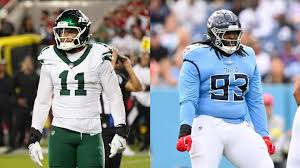
The NFL offseason rarely lacks drama, but the trade between the New York Jets and Tennessee Titans involving Jermaine Johnson and T’Vondre Sweat ( Jermaine Johnson T’Vondre Sweat & the Jets ) has become one of the most talked‑about moves of 2026. For fans, analysts, and fantasy players alike, this swap represents much more than just an exchange of players.
It reflects strategic roster evolution, contract considerations, and coaching philosophies under fire. In this long‑form article, we break down everything you need to know about Jermaine Johnson’s journey, T’Vondre Sweat’s rise, how this affects the Jets, and the future implications of this trade.
Who Is Jermaine Johnson?
Jermaine Johnson is an NFL defensive force whose rise from draft prospect to professional standout has been marked by promise, setbacks, and resilience. Before becoming an NFL first‑round pick, Johnson’s path was anything but straightforward.
After showing early potential at junior college and then at the University of Georgia, he transferred to Florida State, where he exploded onto the national scene with standout pass‑rushing production and elite athleticism. Those achievements helped Johnson earn First‑Team All‑ACC honors and put him on the NFL Draft map.
In 2022, the New York Jets selected Johnson 26th overall in the NFL Draft — a move that signified their belief in his potential to anchor their edge rush for years to come. Indeed, during his second NFL season in 2023, Johnson delivered career‑best numbers, totaling 7.5 sacks, 55 tackles, and an interception, and earned his first Pro Bowl selection.
However, things took a turn in 2024 When Johnson suffered a torn Achilles tendon in just the second game of the season. Despite high hopes entering 2025, his production dipped, with 43 tackles and three sacks across 14 games as he worked back from injury.
Nevertheless, his combination of size (6’5″, 254 lbs), athleticism, and pass‑rush skill continues to draw attention around the league. In a contract year and with a fifth‑year option already exercised, Johnson’s status has been a point of strategic roster decision‑making for the Jets.

The Rise of T’Vondre Sweat
While Jermaine Johnson battled injuries and inconsistent production, T’Vondre Sweat has quietly developed into one of the NFL’s most feared nose tackles. Drafted by the Tennessee Titans with the 38th overall pick in 2024, Sweat brought enormous physical presence and run‑stopping capability right from his rookie year.
At 6‑foot‑4 and 366 pounds, Sweat’s massive frame gives offensive blocks fits and allows his teammates to fly around him. In his NFL debut season (2024), he started all 17 games and finished with 51 total tackles, one sack, and a forced fumble, earning recognition by the Pro Football Writers of America as part of the PFWA All‑Rookie Team.
In 2025, Sweat’s season was interrupted by ankle injuries, yet he still contributed when active, totaling 34 tackles and two sacks in 12 games. That blend of size and productivity made him an intriguing piece for teams looking to improve the interior defensive line.
Ultimately, the Jets saw in Sweat a physical interior presence that could immediately bolster their run defense. More on that later.
The Jets‑Titans Trade
In February 2026, the Jets and Titans agreed to a player‑for‑player trade that will send Jermaine Johnson to Tennessee in exchange for T’Vondre Sweat, effective at the start of the new NFL league year in March.
Although player trades are common, this one drew widespread attention across the league. While Johnson had been a high draft pick with Pro Bowl cachet, his recent performance had not lived up to expectations; Sweat, meanwhile, was seen as a foundational piece at the heart of Tennessee’s defensive line.
Why did this trade make sense for both sides? First, the Titans reunite Johnson with head coach Robert Saleh, who originally drafted him in New York. Saleh knows Johnson’s strengths personally, and the belief is that he can unlock Johnson’s potential again, especially after he returns fully healthy.
Meanwhile, the Jets get a cost‑controlled, heavy‑hitting defensive tackle in T’Vondre Sweat, signed through 2027 with a lower cap number — which helps New York address its run defense woes.

Jets Strategic Roster Thinking:
At first glance, swapping one defender for another might look like a lateral move. History, however, shows us that the context behind a trade often matters more than the headline names.
For the Jets, several factors drove this deal:
A. Salary Cap and Contract Outlook – Jermaine Johnson T’Vondre Sweat & the Jets
Jermaine Johnson was set to count more than $13 million on the 2026 salary cap — a big sum for a player whose production had dipped. By trading him for Sweat, whose cap hit is closer to $1.6–1.7 million this season, New York frees up significant room to pursue free agents or extend young talent.
B. Defensive Philosophy – Jermaine Johnson T’Vondre Sweat & the Jets
Under new defensive coordinator Aaron Glenn, the Jets have emphasized versatility and adaptability. Sweat’s ability to anchor multiple fronts as a nose tackle fits that philosophy better than Johnson’s more specialized edge role — particularly given New York’s chronic struggles against the run.
C. Draft Position & Future Plans – Jermaine Johnson T’Vondre Sweat & the Jets
In addition to the trade, the Jets hold the No. 2 overall draft pick in 2026, allowing them to draft a premier edge rusher if they choose. With Johnson leaving, drafting a high‑impact pass rusher like David Bailey, Arvell Reese, or Rueben Bain Jr. becomes an even more logical strategy.
Thus, this was not just a swap — it was a chess move in a larger plan.
Johnson’s Career
Jermaine Johnson’s career arc is defined by powerful highs and frustrating interruptions. After a promising rookie year in 2022, Johnson’s breakout came in 2023, when he registered his career‑best 7.5 sacks and Pro Bowl honors.
However, the torn Achilles injury in 2024 significantly derailed his momentum. Achilles injuries are among the toughest for edge players to bounce back from — especially those who rely on burst and leverage. Even in 2025, Johnson’s stats were lower than expected, though observers have noted that this might simply be part of the recovery curve.
Nevertheless, Johnson is still only 27 years old, meaning he has time to regain peak form — especially in a familiar defensive scheme under Saleh in Tennessee. What he lacked most recently was consistent pressure on quarterbacks and explosive playmaking, but both traits were part of his game early in his career.
5 “eric slover medal of honor biography”
Sweat’s Fit with the Jets
By acquiring T’Vondre Sweat, the Jets solve several defensive problems at once. Known for elite run defense and interior disruption, Sweat complements New York’s existing edge rushers and linebackers by anchoring the middle of the line.
Moreover, Sweat gives the Jets flexibility. Whereas Johnson was more one‑dimensional as an edge rusher, Sweat offers size that commands double teams and enables linebackers to make plays. In a league where controlling the line of scrimmage is key, this shift might pay dividends for New York’s defense.
In addition, Sweat’s youth (24) and manageable contract make him a cost‑effective piece, allowing the Jets to prioritize other roster needs elsewhere — including bolstering pass rush or secondary talent in upcoming drafts.
To watch t20 world cup:
Trade Reactions
Reactions to the trade have been mixed. Many Jets fans were disappointed to lose a former Pro Bowler, while others acknowledged that Sweat’s skill set better fits the team’s needs.
On social platforms, debates have centered on whether Johnson will rediscover his pre‑injury form or whether the Jets gave up on a former cornerstone too soon.
Analysts, meanwhile, have pointed to the financial logic of the deal as well as the strategic value of resetting the roster around cheaper, younger talent — a common theme across rebuilding teams in the modern NFL.
Final Thoughts
Ultimately, the Jets’ decision to trade Jermaine Johnson for T’Vondre Sweat represents a calculated gamble — one that prioritizes immediate defensive balance, financial flexibility, and draft capital positioning over sentimental attachment to past promise.
As the Jets head into the 2026 season, fans will be watching closely whether Sweat can anchor a revamped defensive front and whether Johnson’s return to form in Tennessee could validate the trade for the Titans. Meanwhile, New York’s ability to capitalize on its high draft pick could very well determine whether this swap becomes a turning point.
Pingback: Israel–Iran Tensions Escalate 2026: Middle East on Edge -
Pingback: Novak Djokovic Skills: Who Redefined Modern Tennis -
Pingback: US–Iran War Fears 2026 | Iran-US Conflict -
Pingback: Heeseung Leaves ENHYPEN – Full Update 2026 -