

Over the years, Novak Djokovic Skills has transformed from a talented Serbian prospect into one of the greatest tennis players in history. Moreover, through resilience, discipline, mental strength, and unmatched consistency, he has reshaped the conversation around the GOAT debate in tennis.
In this comprehensive article, we will explore Novak Djokovic’s career, Grand Slam records, ATP rankings, rivalries with Roger Federer and Rafael Nadal, playing style, fitness secrets, mental toughness, controversies, and legacy.
Furthermore, we will analyze his impact on modern tennis, his dominance at majors like the Australian Open, Wimbledon, French Open, and US Open, and why his name remains at the center of tennis news worldwide.
Early Life: From War-Torn Serbia to World No. 1
Novak Djokovic was born on May 22, 1987, in Belgrade, Serbia. At that time, Serbia was facing political instability and economic hardship. Nevertheless, despite limited resources, Djokovic’s parents supported his tennis ambitions.
Interestingly, his early training began at mountain resorts where tennis courts were sometimes located near conflict zones. However, instead of breaking his spirit, those challenges strengthened his mental resilience.
Consequently, by his teenage years, Djokovic was already competing in junior tennis tournaments, showing signs of elite potential. Soon after, he transitioned into professional tennis, entering ATP events and gradually climbing the rankings.
Rise Through the ATP Rankings – Novak Djokovic Skills
Initially, Djokovic was viewed as a promising but inconsistent player behind Federer and Nadal. However, everything changed in 2008 when he won his first Grand Slam title at the Australian Open.
Afterward, he continued improving. Then, in 2011, Djokovic produced one of the greatest seasons in ATP Tour history. Not only did he defeat Federer and Nadal multiple times, but he also won three Grand Slam titles in a single year.
As a result, he reached ATP World No. 1, marking the beginning of a historic era. Over time, he would go on to break records for:
- Most weeks at World No. 1
- Most year-end No. 1 finishes
- Most Grand Slam titles in men’s tennis
- Most Masters 1000 titles
Therefore, his dominance was not temporary — it was sustained excellence.
Grand Slam Dominance
When discussing Novak Djokovic, one cannot ignore his Grand Slam record. He has achieved extraordinary success across all surfaces:
Australian Open King – Novak Djokovic Skills
Djokovic has won the Australian Open a record number of times. His dominance on hard courts in Melbourne is unmatched. Moreover, his flexibility, return of serve, and baseline defense make him nearly unstoppable there.
Wimbledon Mastery – Novak Djokovic Skills
At Wimbledon, Djokovic has defeated multiple champions on grass. Notably, he has won several finals against Federer, proving his composure under pressure.
French Open Triumphs – Novak Djokovic Skills
Although clay is traditionally Nadal’s territory, Djokovic has managed to win multiple French Open titles, defeating Nadal at Roland Garros — an achievement very few players can claim.
US Open Success – Novak Djokovic Skills
At the US Open, Djokovic has battled through intense five-set matches, demonstrating endurance and mental toughness.
Consequently, his ability to win on hard court, grass, and clay solidifies his all-surface greatness.
Rivalries That Defined an Era
Djokovic vs Federer – Novak Djokovic Skills
The rivalry between Novak Djokovic and Roger Federer is one of the most iconic in tennis history. While Federer was known for elegance and attacking style, Djokovic brought defensive mastery and counterpunching brilliance.
Moreover, Djokovic defeated Federer in multiple Grand Slam finals, including dramatic Wimbledon encounters. Therefore, their rivalry elevated tennis popularity worldwide.
Djokovic vs Nadal – Novak Djokovic Skills
Equally intense was his rivalry with Rafael Nadal. Their battles at the French Open and Australian Open became legendary. For instance, the 2012 Australian Open final lasted nearly six hours — one of the longest Grand Slam finals ever. As a result, their rivalry is considered one of the greatest in sports history.
Playing Style: Why Novak Is So Effective
Novak Djokovic’s playing style combines:
- Elite return of serve
- Defensive flexibility
- Baseline consistency
- Tactical intelligence
- Mental endurance
Unlike many aggressive players, Djokovic thrives on long rallies. Furthermore, his backhand is widely regarded as one of the best two-handed backhands in tennis history.
Additionally, his ability to slide on hard courts and retrieve impossible shots often frustrates opponents. Thus, his game is built on precision, patience, and psychological pressure.
Elite Return of Serve – The Foundation of His Dominance
First and foremost, Djokovic’s return of serve is widely considered the greatest in tennis history. While most players focus on holding serve, Djokovic wins matches by consistently breaking opponents.
Technical Positioning
Unlike aggressive returners who stand far inside the baseline, Djokovic adjusts his court position based on the server. Against big servers, he often stands slightly deeper, giving himself extra reaction time. However, against second serves, he steps forward and applies immediate pressure.
Reaction Speed
His split-step timing is almost flawless. As soon as the opponent makes contact with the ball, Djokovic is already balanced and ready to move. Consequently, even serves above 130 mph are returned deep and controlled.
Neutralizing Big Servers
Against elite servers, many players struggle to generate offense. However, Djokovic does the opposite—he neutralizes pace and redirects it. Therefore, instead of playing defensive tennis after the return, he frequently starts rallies in control.
Psychological Pressure
Because opponents know their serve will not guarantee easy points, they feel additional pressure. As a result, double faults and risky second serves often increase under stress. In summary, Djokovic’s return of serve transforms defense into immediate offense.
Defensive Flexibility – Turning Defense into Offense
Secondly, Djokovic’s defensive flexibility separates him from nearly every other player.
Physical Elasticity
Thanks to yoga, stretching, and specialized flexibility training, Djokovic can slide on hard courts, stretch into splits, and recover balance instantly. This allows him to reach balls that appear unreachable.
Court Coverage
He moves laterally with extraordinary efficiency. Moreover, his footwork is economical—meaning he rarely wastes movement. Consequently, he conserves energy while forcing opponents into longer rallies.
Counterpunching Mastery
Unlike pure defensive players who simply retrieve shots, Djokovic counterattacks. For example, when pulled wide, he often redirects the ball down the line with precision, immediately reversing the rally dynamic.
Sliding on All Surfaces
While sliding is common on clay, Djokovic also slides effectively on hard courts. This gives him stability and balance even during extreme defensive situations. Therefore, his defense is not passive—it is strategically aggressive.
Baseline Consistency – The Engine of Long Rallies
Modern tennis is dominated by baseline exchanges, and Djokovic thrives in this environment.
Two-Handed Backhand
His backhand is arguably one of the best ever. Not only is it stable under pressure, but it is also versatile. He can:
- Drive it crosscourt with depth
- Redirect it down the line
- Absorb heavy topspin
- Flatten it for winners
Because of this, opponents cannot easily attack his backhand wing—a rare trait in professional tennis.
Forehand Precision
While not as flashy as some power hitters, his forehand is reliable and accurate. He generates controlled aggression rather than reckless power.
Depth and Placement
Djokovic consistently hits deep balls that push opponents behind the baseline. As a result, rivals struggle to step inside the court.
Unforced Error Control
Perhaps most importantly, he minimizes unforced errors. Therefore, he forces opponents to win points rather than gifting them.
In essence, his baseline game is built on patience and precision rather than risk.
Tactical Intelligence – The Strategic Mind
Beyond physical skills, Djokovic’s tennis IQ is exceptional.
Reading Opponents
He studies opponent patterns carefully. For instance, he identifies weaker wings, predictable serving patterns, or movement limitations.
Mid-Match Adjustments
If Plan A fails, Djokovic adapts. He may:
- Increase rally pace
- Change return positioning
- Use drop shots
- Target specific corners
Exploiting Momentum
Djokovic understands match momentum deeply. When he senses vulnerability, he raises intensity immediately. Therefore, short lapses from opponents become decisive breaks.
Big-Point Awareness
On crucial points—break points or tie-breaks—he chooses high-percentage plays rather than risky winners. Thus, strategy becomes one of his greatest weapons.
Mental Endurance – The Ultimate Separator
While technical skills are vital, Djokovic’s mental endurance may be his most powerful asset.
Handling Pressure
He has saved match points in Grand Slam finals and won marathon matches lasting over five hours. Instead of panicking, he becomes calmer in pressure situations.
Emotional Reset Ability
Even after losing a set badly, he resets mentally. Consequently, momentum swings rarely defeat him permanently.
Crowd Resistance
In hostile environments, Djokovic often uses negative crowd energy as motivation. Rather than losing focus, he channels it into performance.
Physical and Mental Synchronization
Long rallies demand not only stamina but also concentration. Djokovic maintains focus deep into fifth sets, where many players mentally fade. Therefore, his mental strength transforms tight matches into victories.
Mental Strength: The Ultimate Weapon
Perhaps Djokovic’s greatest strength is mental toughness. Time and again, he has saved match points and won from losing positions.
For example:
- Saving championship points at Wimbledon
- Recovering from two sets down
- Winning tie-breaks under extreme pressure.
Fitness, Diet, and Longevity
Djokovic follows a strict gluten-free diet. He practices yoga, meditation, and breathing techniques. Furthermore, he prioritizes flexibility and recovery.
As a result, even in his mid-30s, he competes at the highest level against younger players. His commitment to sports science, injury prevention, and discipline contributes significantly to his longevity.
Records and Achievements
Novak Djokovic holds numerous ATP records:
- Most weeks as World No. 1
- Most Masters 1000 titles
- Career Golden Masters (winning all Masters 1000 events)
- Multiple year-end championships titles
Therefore, statistically speaking, he has a strong claim in the GOAT debate.
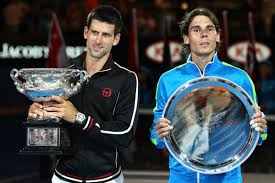
1. 2012 Australian Open Final vs Rafael Nadal
Event: Australian Open – Men’s Singles Final
Date: Jan 29, 2012
Result: Djokovic d. Nadal 5–7, 6–4, 6–2, 6–7(5–7), 7–5
Details:
This match is widely regarded as one of the greatest Grand Slam finals ever played. Djokovic and Nadal battled for 5 hours and 53 minutes, making it the longest men’s major final in history. Djokovic lost the first set, recovered brilliantly, then saved match points in a fourth-set tiebreak before finally clinching victory in a dramatic fifth set. This match showcased Djokovic’s elite physical conditioning, mental endurance, and tactical adaptability on hard court — traits that would define his career.
2. 2019 Wimbledon Final vs Roger Federer
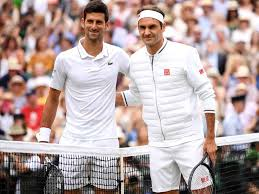
Event: Wimbledon – Men’s Singles Final
Date: July 14, 2019
Result: Djokovic d. Federer 7–6(5), 1–6, 7–6(4), 4–6, 13–12(3)
Details:
This match took place on Centre Court and lasted nearly 5 hours, making it the longest Wimbledon final in history. Djokovic and Federer traded momentum, with Federer dominating the second set and Djokovic winning the key tiebreaks. The final set went to 12–12 before Djokovic clinched the title in a historic finish under the new Wimbledon final-set tiebreak rule. This match is often highlighted for Djokovic’s mental toughness under pressure and his ability to win crucial points late in extended encounters.
3. 2026 Australian Open Final vs Carlos Alcaraz
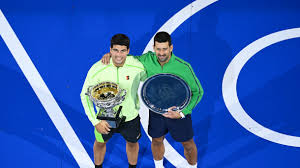
Event: Australian Open – Men’s Singles Final
Date: February 1, 2026
Result: Alcaraz d. Djokovic 2–6, 6–2, 6–3, 7–5
Details:
In a highly anticipated clash between generations, Djokovic started strongly, taking the first set before the younger Carlos Alcaraz rallied to win the next three. This match was significant as it marked Alcaraz’s completion of a career Grand Slam, and signaled a shift in momentum in the GOAT conversation. Djokovic still displayed his trademark baseline precision and return excellence in the opening set, but Alcaraz’s power and athleticism prevailed in later stages.
4. 2025 Wimbledon Semi-Final vs Jannik Sinner
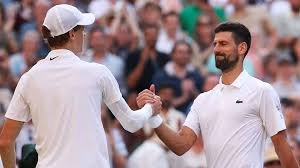
Event: Wimbledon – Men’s Singles Semi-Final
Date: July 11, 2025
Result: Sinner d. Djokovic 6–3, 6–3, 6–4
Details:
In this straight-sets victory, Jannik Sinner delivered one of the most complete performances of his career against Djokovic. Sinner’s forehand depth and consistency neutralized Djokovic’s timing, while precise serving kept the Serbian on the defensive. This win was notable because it prevented Djokovic from reaching another Wimbledon final, demonstrating how emerging stars are challenging his dominance even at age 38.
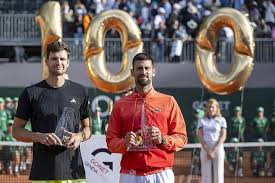
5. Geneva Open Final 2025 vs Hubert Hurkacz
Event: Geneva Open (ATP 250) – Final
Date: May 24, 2025
Result: Djokovic d. Hurkacz 5–7, 7–6(2), 7–6(2)
Details:
At age 38, Djokovic fought back from a set down to secure his 100th ATP Tour title, joining only Jimmy Connors and Roger Federer in the exclusive milestone club. The match was tight, featuring two close tiebreaks which Djokovic won by maintaining his trademark defense and clutch serving when it mattered most. This victory highlighted his longevity and ability to perform deep into long matches even late in his career.
Bonus Match Context: Grand Slam Milestone
2026 Australian Open vs Botic van de Zandschulp — Djokovic recorded his 400th Grand Slam win, tying Federer’s record for most wins at the Australian Open alone and underscoring his continued excellence in majors.
Summary of These Matches
| Match | Tournament | Result | Notable Contribution |
|---|---|---|---|
| 2012 Aus Open Final vs Nadal | Grand Slam Final | Win | Longest major final ever |
| 2019 Wimbledon Final vs Federer | Grand Slam Final | Win | Historic five-set battle |
| 2026 Aus Open Final vs Alcaraz | Grand Slam Final | Loss | Generational showdown |
| 2025 Wimbledon Semi vs Sinner | Semi-Final | Loss | Emerging star beats legend |
| 2025 Geneva Open Final vs Hurkacz | ATP Final | Win | 100th career title |
Controversies and Challenges
However, Djokovic’s career has not been without controversy.
For instance:
- Visa issues during the Australian Open 2022
- On-court outbursts
- Disqualification at the US Open 2020
Influence on Modern Tennis
Novak has inspired a new generation of Serbian players. Moreover, he established tennis academies and charity foundations supporting children’s education.
Additionally, his success increased tennis popularity in Eastern Europe. Thus, his influence extends beyond trophies.
The GOAT Debate
The GOAT debate in tennis includes three names: Djokovic, Federer, and Nadal.
However, when comparing:
- Grand Slam titles
- Head-to-head records
- Weeks at No. 1
- Masters titles
Djokovic’s statistical resume stands exceptionally strong.
Therefore, many analysts consider him the most complete player in tennis history.
Current Form and Future Prospects
Even as younger players like Carlos Alcaraz emerge, Djokovic remains competitive.
Moreover, his experience in high-pressure situations gives him an edge in Grand Slam tournaments. Consequently, retirement speculation continues, yet he still competes for major titles.
Conclusion
Novak Djokovic’s journey from Serbia to global superstardom represents resilience, discipline, and greatness. Furthermore, his dominance across surfaces, mental strength, and unmatched consistency have redefined modern tennis.
Whether one supports Federer, Nadal, or Djokovic, it is undeniable that Novak has left an indelible mark on tennis history. Ultimately, the name “Novak” symbolizes not just a player — but an era of excellence.
Pingback: Complete Story Of Joan Lunden -
Pingback: Profile Of Tim Sheehy -
Pingback: Britney Spears Arrest Rumors Explained -
Pingback: UFC 326: Max Holloway vs Charles Oliveira 2 Complete Fight -
Pingback: Rafael Nadal - The Tennis Superstar -
Pingback: NBA Match Preview: Pacers vs Lakers 2026 -