
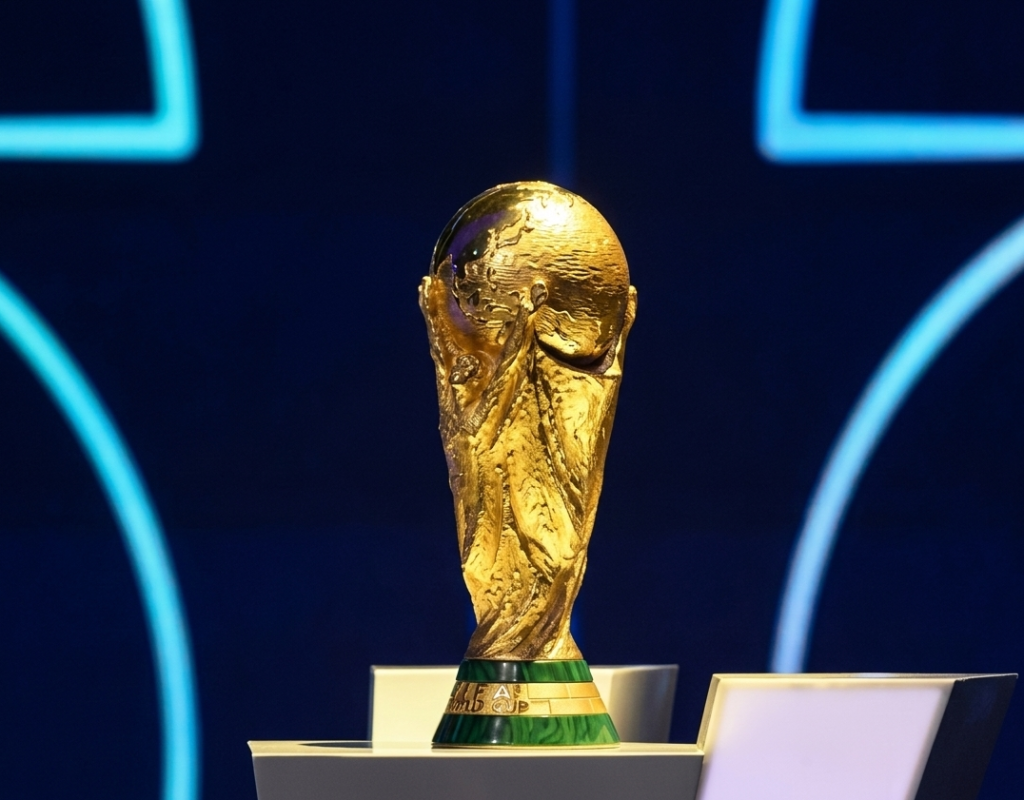
FIFA World Cup 2026
The Biggest FIFA Tournament 2026 WC is set to be the biggest edition of the world’s most anticipated football tournament. For the first time, the event will feature 48 teams, competing in 104 matches across three host countries – the United States, Canada, and Mexico. In this FIFA World Cup 2026 Blog, we will share every detail about FIFA.
With an expanded format and more nations than ever before, this tournament promises unforgettable moments, surprises, and global football drama.
World Cup 2026 Overview
- Biggest FIFA Tournament 2026 WC: June 11, 2026 – July 19, 2026
- Host Countries: USA, Canada, Mexico
- Total Teams Participated: 48
- Total Matches: 104
- Format:
- Group Stage → Round of 32 → Round of 16 → Quarterfinals → Semifinals → Third Place Match → Final
FIFA 2026 World Cup Groups & Teams
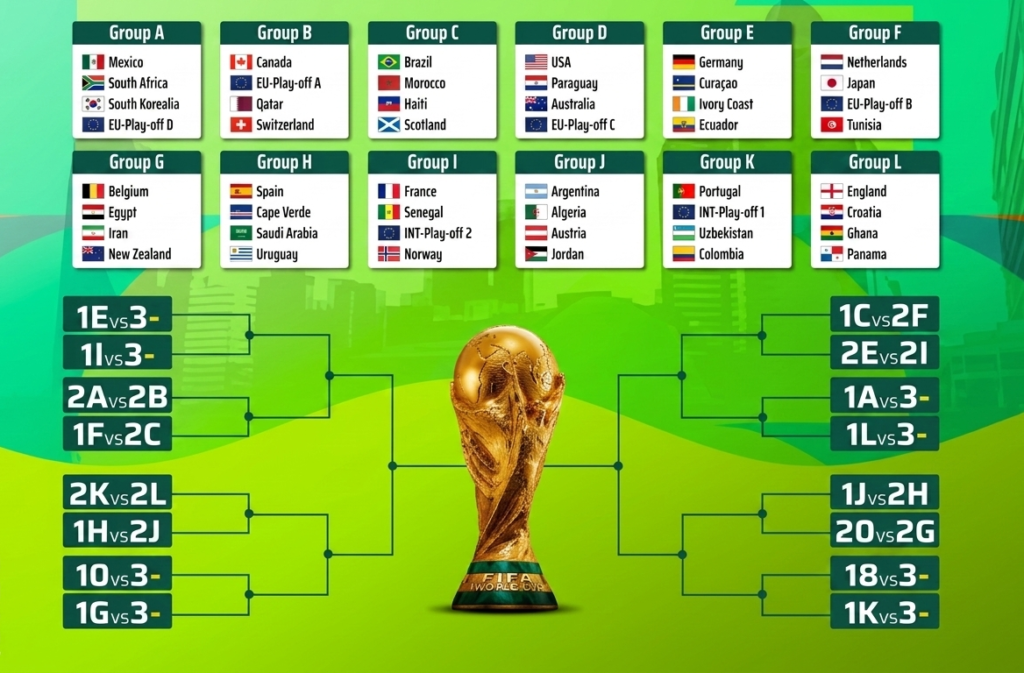
Group stage includes 12 groups of four teams each.
i) Group A – FIFA World Cup 2026 Blog
| Team | Country |
|---|---|
| Mexico | 🇲🇽 Host |
| South Africa | 🇿🇦 |
| South Korea | 🇰🇷 |
| UEFA Playoff D Winner | TBD (Denmark/North Macedonia/Czechia/Ireland) |
ii) Group B
| Team |
|---|
| Canada 🇨🇦 (Host) |
| UEFA Playoff A Winner |
| Qatar 🇶🇦 |
| Switzerland 🇨🇭 |
iii) Group C
| Team |
|---|
| Brazil |
| Morocco |
| Haiti |
| Scotland |
iv) Group D
| Team |
|---|
| United States 🇺🇸 |
| Paraguay 🇵🇾 |
| Australia 🇦🇺 |
| UEFA Playoff C |
v) Group E
| Team |
|---|
| Germany 🇩🇪 |
| Curaçao 🇨🇼 |
| Côte d’Ivoire 🇨🇮 |
| Ecuador 🇪🇨 |
vi) Group F
| Team |
|---|
| Netherlands 🇳🇱 |
| Japan 🇯🇵 |
| UEFA Playoff B |
| Tunisia 🇹🇳 |
vi) Group G
| Team |
|---|
| Belgium 🇧🇪 |
| Egypt 🇪🇬 |
| Iran 🇮🇷 |
| New Zealand 🇳🇿 |
vii) Group H
| Team |
|---|
| Spain 🇪🇸 |
| Cape Verde 🇨🇻 |
| Saudi Arabia 🇸🇦 |
| Uruguay 🇺🇾 |
viii) Group I
| Team |
|---|
| France 🇫🇷 |
| Senegal 🇸🇳 |
| FIFA Playoff 2 |
| Norway 🇳🇴 |
ix) Group J
| Team |
|---|
| Argentina 🇦🇷 |
| Algeria 🇩🇿 |
| Austria 🇦🇹 |
| Jordan 🇯🇴 |
x) Group K
| Team |
|---|
| Portugal 🇵🇹 |
| FIFA Playoff 1 |
| Uzbekistan 🇺🇿 |
| Colombia 🇨🇴 |
xi) Group L
| Team |
|---|
| England |
| Croatia 🇭🇷 |
| Ghana 🇬🇭 |
| Panama 🇵🇦 |
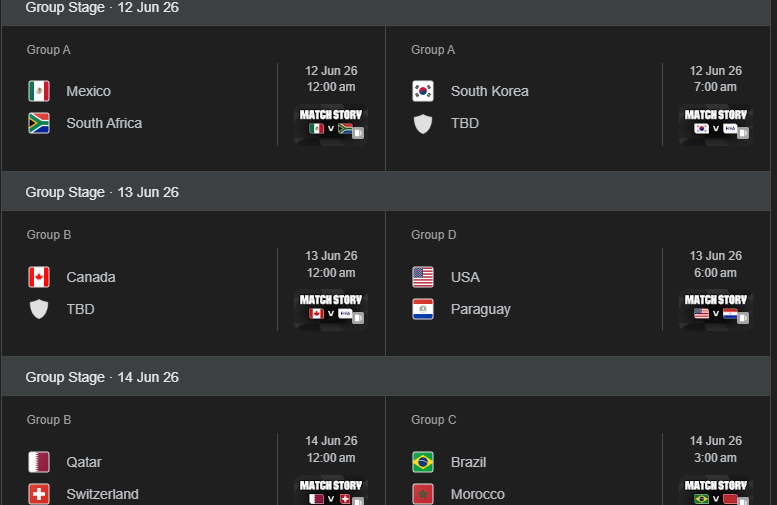
FIFA World Cup 2026 Schedule – Group Stage
Here’s the group stage fixture list you can use to follow every match:
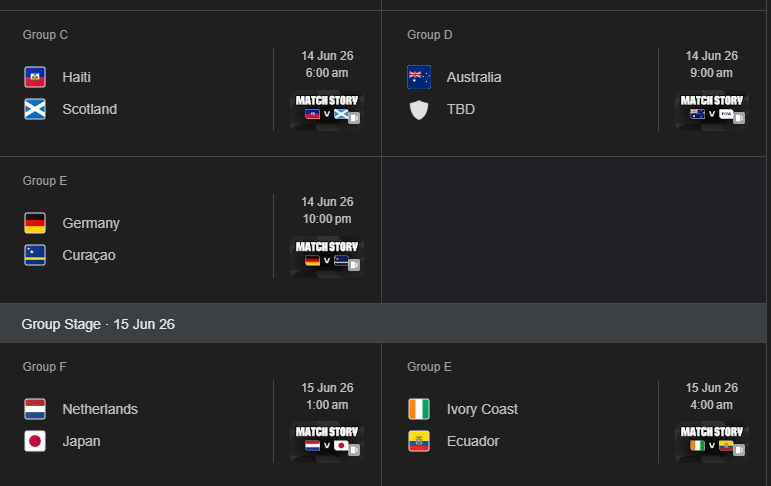
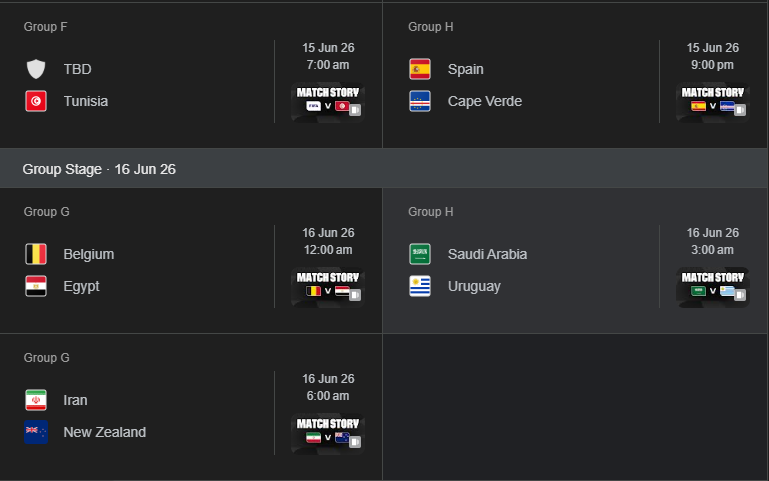
11 June to June 14 | FIFA World Cup 2026 Blog
| Date | Match | Group |
|---|---|---|
| Jun 11 | Mexico vs South Africa | A |
| 11 Jun | South Korea vs UEFA Playoff D | A |
| Jun 12 | Canada vs UEFA Playoff A | B |
| 13 Jun | Qatar vs Switzerland | B |
| Jun 13 | Brazil vs Morocco | C |
| 13 Jun | Haiti vs Scotland | C |
| Jun 13 | USA vs Paraguay | D |
| 13 Jun | Australia vs UEFA Playoff C | D |
| Jun 14 | Germany vs Curaçao | E |
| 14 Jun | Netherlands vs Japan | F |
| Jun 14 | Ivory Coast vs Ecuador | E |
| 14 Jun | UEFA Playoff B vs Tunisia | F |
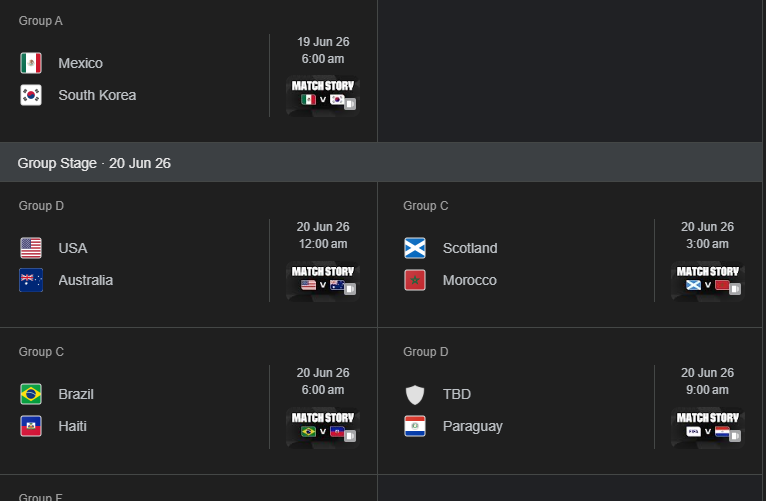
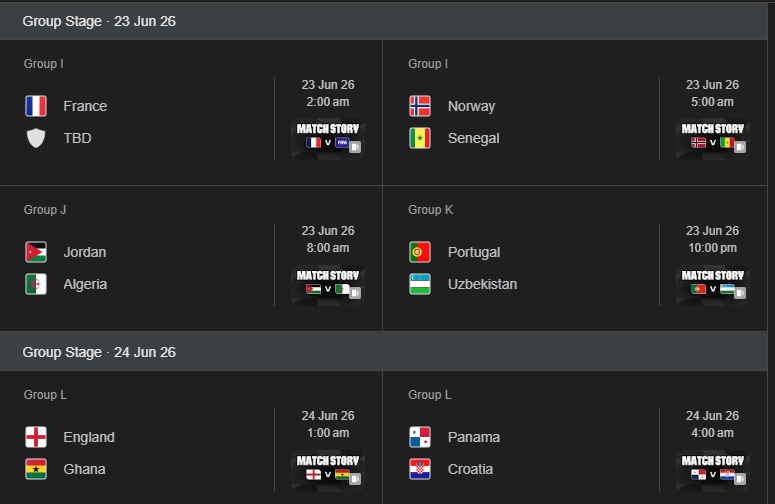
18 June to June 23 | FIFA World Cup 2026 Blog
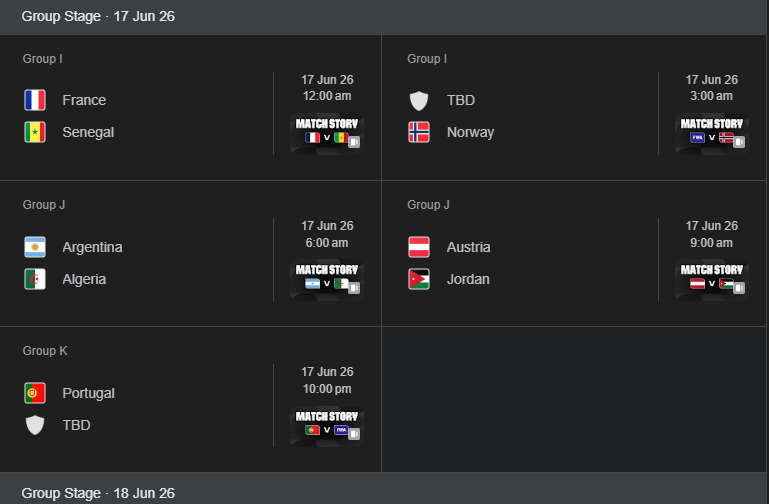
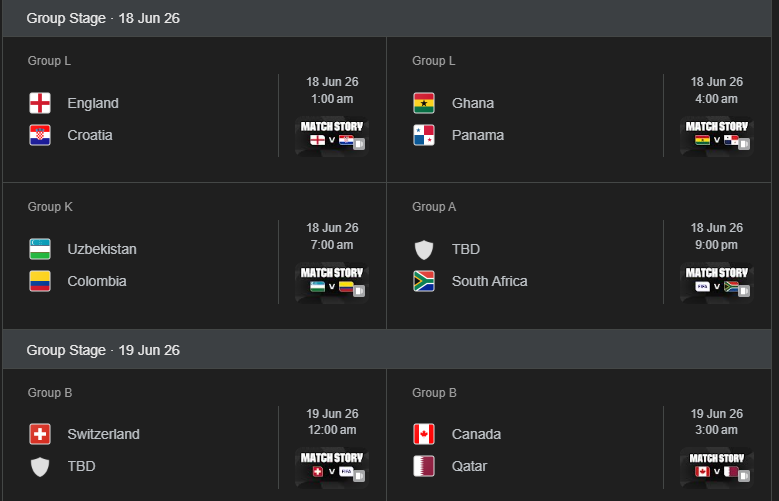
| Date | Match | Group |
|---|---|---|
| Jun 18 | UEFA Playoff D vs South Africa | A |
| 18 Jun | Switzerland vs UEFA Playoff A | B |
| Jun 18 | Canada vs Qatar | B |
| 18 Jun | Mexico vs South Korea | A |
| Jun 19 | USA vs Australia | D |
| 19 Jun | Scotland vs Morocco | C |
| Jun 19 | Brazil vs Haiti | C |
| 20 Jun | Netherlands vs UEFA Playoff B | F |
| Jun 20 | Germany vs Ivory Coast | E |
| 20 Jun | Ecuador vs Curaçao | E |
| Jun 20 | Tunisia vs Japan | F |
| 21 Jun | Spain vs Saudi Arabia | H |
| Jun 21 | Belgium vs Iran | G |
| 21 Jun | Uruguay vs Cape Verde | H |
| Jun 21 | New Zealand vs Egypt | G |
| 22 Jun | Argentina vs Austria | J |
| Jun 22 | France vs FIFA Playoff 2 | I |
| 22 Jun | Norway vs Senegal | I |
| Jun 22 | Jordan vs Algeria | J |
| 23 Jun | Portugal vs Uzbekistan | K |
| Jun 23 | England vs Ghana | L |
| 23 Jun | Panama vs Croatia | L |
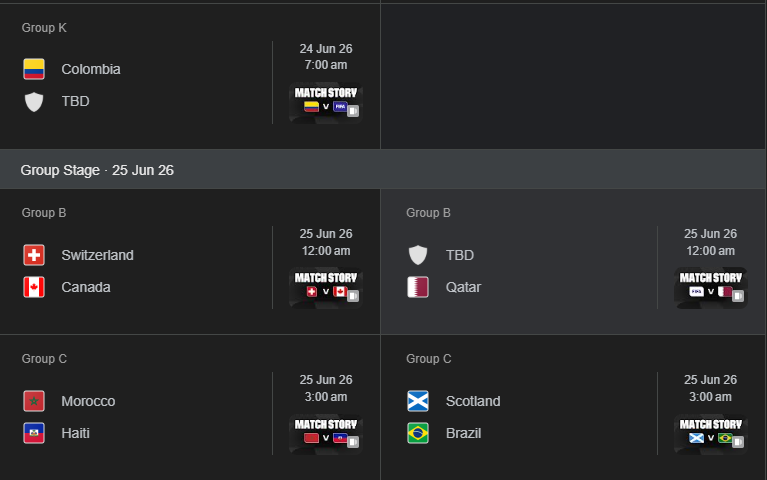
| Jun 23 | Colombia vs FIFA Playoff 1 | K |
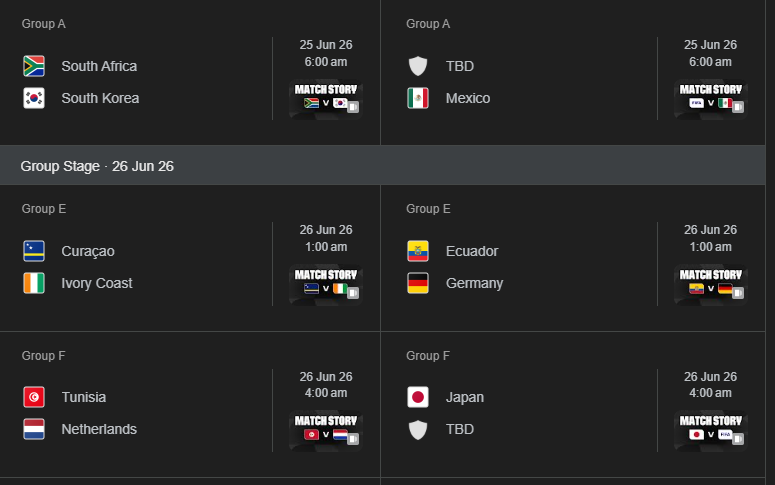
24 June to June 27 | FIFA World Cup 2026 Blog
| Date | Match | Group |
|---|---|---|
| 24 Jun | Switzerland vs Canada | B |
| Jun 24 | UEFA Playoff A vs Qatar | B |
| 24 Jun | Brazil vs Scotland | C |
| Jun 24 | Morocco vs Haiti | C |
| 24 Jun | UEFA Playoff D vs Mexico | A |
| Jun 24 | South Africa vs South Korea | A |
| 25 Jun | Curaçao vs Ivory Coast | E |
| Jun 25 | Ecuador vs Germany | E |
| 25 Jun | Japan vs UEFA Playoff B | F |
| Jun 25 | Tunisia vs Netherlands | F |
| 25 Jun | UEFA Playoff C vs USA | D |
| Jun 25 | Paraguay vs Australia | D |
| 26 Jun | Norway vs France | I |
| Jun 26 | Senegal vs FIFA Playoff 2 | I |
| 26 Jun | Cape Verde vs Saudi Arabia | H |
| Jun 26 | Uruguay vs Spain | H |
| 26 Jun | Egypt vs Iran | G |
| Jun 26 | New Zealand vs Belgium | G |
| 27 Jun | Panama vs England | L |
| Jun 27 | Croatia vs Ghana | L |
| 27 Jun | Colombia vs Portugal | K |
| Jun 27 | FIFA Playoff 1 vs Uzbekistan | K |
| 27 Jun | Algeria vs Austria | J |
| Jun 27 | Jordan vs Argentina | J |
Knockout Rounds – Dates & Format
Once the group stage concludes (June 27), the top two teams from each group, plus the eight best third‑place teams, advance to the Round of 32.
Here’s how the knockout schedule is planned:
| Stage | Dates |
|---|---|
| Round of 32 | June 28 – July 3 |
| Round of 16 | July 4 – July 7 |
| Quarterfinals | July 9 – July 11 |
| Semifinals | July 14 – July 15 |
| Third Place Match | July 18 |
| Final | July 19, 2026 |
Teams – Qualification & Playoffs
As of the latest updates:
- 42 teams have already qualified for the tournament.
- The final six places will be decided through the FIFA Play‑Off Tournament in March 2026.
Note: Some groups include “UEFA Playoff” or “FIFA Playoff” placeholders, referring to teams that will be confirmed after the March 2026 playoff matches.
Final Notes on FIFA World Cup 2026 Blog
- The Biggest FIFA Tournament 2026 WC is the first with 48 teams, making it the largest ever.
- Matches will be held across multiple stadiums in three countries, reaching huge global audiences.
Whether you’re tracking your favorite national team or planning to follow the tournament live, this guide gives you everything you need — from group draws to match dates and the full schedule.
World’s 10 top football teams:
1- Argentina national football team – FIFA World Cup 2026 Blog
2- France national football team – FIFA World Cup 2026 Blog
3- Brazil national football team – FIFA World Cup 2026 Blog
4- England national football team – FIFA World Cup 2026 Blog
5- Spain national football team – FIFA World Cup 2026 Blog
6- Portugal national football team – FIFA World Cup 2026 Blog
7- Germany national football team – FIFA World Cup 2026 Blog
8- Netherlands national football team – FIFA World Cup 2026 Blog
9- Italy national football team – FIFA World Cup 2026 Blog
10- Belgium national football team – FIFA World Cup 2026 Blog
Top 10 Best Football Clubs
1️⃣ Real Madrid CF (Spain) || FIFA World Cup 2026 Blog
- One of the most successful clubs in history
- Record UEFA Champions League titles || FIFA World Cup 2026 Blog
- Legendary players like Cristiano Ronaldo and Luka Modrić played key roles
2️⃣ Manchester City FC (England) || FIFA World Cup 2026 Blog
- Dominant in recent years under Pep Guardiola
- Won the 2023 UEFA Champions League || FIFA World Cup 2026 Blog
3️⃣ FC Barcelona (Spain) || FIFA World Cup 2026 Blog
- Famous for tiki-taka football
- Produced legends like Lionel Messi, Xavi Hernández
4️⃣ Bayern Munich (Germany) || FIFA World Cup 2026 Blog
- Most successful German club
- Regularly dominates the Bundesliga
5️⃣ Liverpool FC (England) || FIFA World Cup 2026 Blog
- Strong history in the Premier League and UEFA Champions League
- Modern success under Jürgen Klopp
6️⃣ Paris Saint‑Germain FC (France) || FIFA World Cup 2026 Blog
- Dominant in Ligue 1
- Hosted stars like Kylian Mbappé and Neymar
7️⃣ Arsenal FC (England) || FIFA World Cup 2026 Blog
- Historic English club
- Strong revival in recent seasons
8️⃣ Chelsea FC (England) || FIFA World Cup 2026 Blog
- Multiple Champions League titles
- Known for strong European performances
9️⃣ Inter Milan (Italy)
- Major club in Serie A
- Reached Champions League finals recently
🔟 AC Milan (Italy)
- One of the most successful clubs in European history
- Legendary players like Paolo Maldini
1- Argentina National Football Team
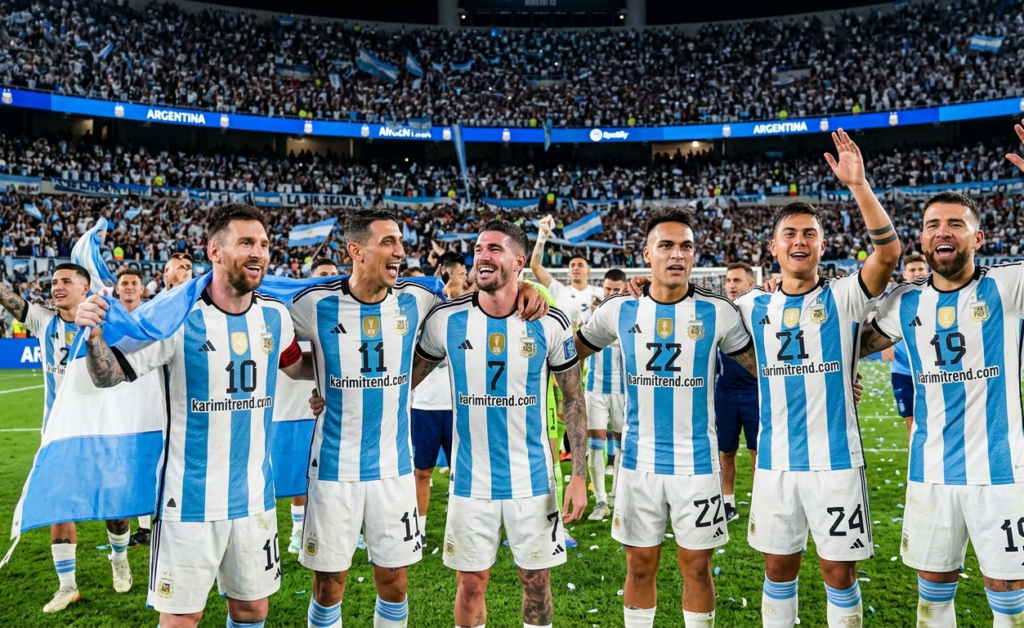
The Argentina national football team is one of the most successful and famous teams in international football history. Representing the country of Argentina, the team is controlled by the Argentine Football Association (AFA). Known for its attacking football and legendary players, Argentina has produced some of the greatest footballers in history.
Foundation and Early History
The Argentina national team was officially formed in 1901 when Argentina played its first international match against Uruguay national football team.
- First Match: May 16, 1901
- Result: Argentina defeated Uruguay 3–2
- Venue: Montevideo
During the early years of football in South America, Argentina quickly became one of the strongest teams on the continent.
Argentina was also one of the founding members of the South American football federation CONMEBOL.
Major Tournament History
FIFA World Cup
Argentina is one of the most successful teams in the history of the FIFA World Cup.
World Cup Titles
Argentina has won the World Cup three times:
1978 – Argentina
- Host nation Argentina won their first World Cup.
- Star player: Mario Kempes
1986 – Mexico
- One of the greatest World Cup performances ever by
Diego Maradona. - Famous matches included the quarter-final against England national football team featuring the “Hand of God” goal.
2022 – Qatar
- Argentina defeated France national football team in one of the greatest finals in football history.
- Captain Lionel Messi led the team to victory.
Copa América Success
Argentina is also very successful in the Copa América, the main South American football tournament.
Total Titles: 15
Famous victories include:
- 1921
- 1925
- 1927
- 1941
- 1945
- 1946
- 1947
- 1955
- 1957
- 1959
- 1991
- 1993
- 2021 (Messi’s first international trophy)
Top 5 Legendary Players of Argentina (All Time)
Argentina has produced many of the greatest football players in history.
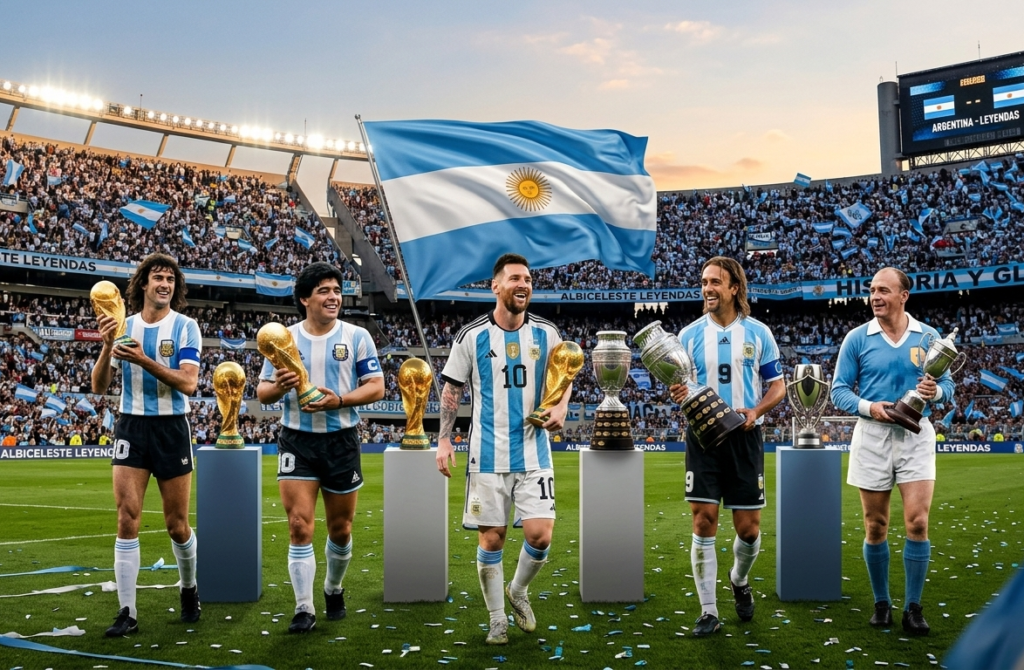
1️⃣ Diego Maradona
- One of the greatest players ever
- Led Argentina to the 1986 World Cup
- Famous for the Goal of the Century
Quick Information Table
| Detail | Information |
|---|---|
| Full Name | Diego Armando Maradona |
| Date of Birth | October 30, 1960 |
| Birth Place | Lanús, Argentina |
| Nationality | Argentine |
| Height | 1.65 m |
| Position | Attacking Midfielder / Forward |
| National Team | Argentina national football team |
| International Matches | 91 |
| International Goals | 34 |
| Famous Jersey Number | 10 |
| Death | November 25, 2020 |
Club Career Table
| Years | Club | Matches | Goals |
|---|---|---|---|
| 1976–1981 | Argentinos Juniors | 167 | 115 |
| 1981–1982 | Boca Juniors | 40 | 28 |
| 1982–1984 | FC Barcelona | 58 | 38 |
| 1984–1991 | SSC Napoli | 259 | 115 |
| 1992–1993 | Sevilla FC | 29 | 7 |
| 1993–1994 | Newell’s Old Boys | 5 | 0 |
| 1995–1997 | Boca Juniors | 30 | 7 |
FIFA World Cup Participation
| Year | Tournament | Result |
|---|---|---|
| 1982 | FIFA World Cup Spain | Second Round |
| 1986 | FIFA World Cup Mexico | Champion |
| 1990 | FIFA World Cup Italy | Runner-up |
| 1994 | FIFA World Cup USA | Round of 16 |
Major Achievements Table
| Achievement | Year |
|---|---|
| FIFA World Cup Champion | 1986 |
| World Cup Runner-up | 1990 |
| UEFA Cup with Napoli | 1989 |
| Serie A Champion | 1987, 1990 |
| FIFA Player of the 20th Century | 2000 |
Famous Goals / Moments
| Moment | Tournament |
|---|---|
| Hand of God Goal | 1986 World Cup |
| Goal of the Century | 1986 World Cup |
| Argentina World Cup Victory | 1986 |
2️⃣ Lionel Messi
- Widely considered the greatest footballer of all time
- Won the 2022 World Cup
- Record goalscorer for Argentina
Basic Information Table
| Detail | Information |
|---|---|
| Full Name | Lionel Andrés Messi |
| Date of Birth | June 24, 1987 |
| Birthplace | Rosario, Argentina |
| Nationality | Argentine |
| Height | 1.70 m |
| Position | Forward / Attacking Midfielder |
| Current Club | Inter Miami CF |
| National Team | Argentina national football team |
| Jersey Number | 10 |
| Nickname | La Pulga (The Flea) |
Club Career Table
| Years | Club | Matches | Goals |
|---|---|---|---|
| 2004–2021 | FC Barcelona | 778 | 672 |
| 2021–2023 | Paris Saint‑Germain FC | 75 | 32 |
| 2023–Present | Inter Miami CF | 50+ | 40+ |
International Career Table
| Category | Stats |
|---|---|
| National Team | Argentina national football team |
| International Matches | 180+ |
| International Goals | 100+ |
| Debut | 2005 |
Major Trophies
| Trophy | Year |
|---|---|
| FIFA World Cup | 2022 |
| Copa América | 2021 |
| Finalissima | 2022 |
| UEFA Champions League | 2006, 2009, 2011, 2015 |
| La Liga Titles | 10 |
Individual Awards
| Award | Times Won |
|---|---|
| Ballon d’Or | 8 |
| FIFA Best Player | Multiple |
| European Golden Shoe | 6 |
Career Records
| Record | Detail |
|---|---|
| Barcelona All-time Top Scorer | Yes |
| Argentina All-time Top Scorer | Yes |
| Most Ballon d’Or Wins | 8 |
| World Cup Golden Ball | 2014, 2022 |
3️⃣ Gabriel Batistuta
- One of Argentina’s best strikers
- Famous for powerful goals
Gabriel Batistuta is one of the greatest strikers in the history of the Argentina national football team. Known for his powerful shots, incredible finishing ability, and leadership, Batistuta became a legend of world football during the 1990s and early 2000s. Fans around the world called him “Batigol” because of his amazing goal-scoring record.
Early Life
Gabriel Batistuta was born on February 1, 1969, in Reconquista, a city in Argentina.
Interestingly, Batistuta initially loved basketball more than football. However, after watching Argentina national football team win the 1978 FIFA World Cup, he became inspired to play football.
His natural talent quickly made him one of the most promising young players in Argentina.
Basic Information
| Detail | Information |
|---|---|
| Full Name | Gabriel Omar Batistuta |
| Date of Birth | February 1, 1969 |
| Birthplace | Reconquista, Argentina |
| Height | 1.85 m |
| Position | Striker |
| Nickname | Batigol |
| National Team | Argentina national football team |
Club Career
Batistuta played for several clubs in Argentina, Italy, and Qatar. However, he became most famous for his incredible performances with ACF Fiorentina in Italy.
Club Career Overview
| Years | Club |
|---|---|
| 1988–1989 | Newell’s Old Boys |
| 1989–1990 | River Plate |
| 1990–1991 | Boca Juniors |
| 1991–2000 | ACF Fiorentina |
| 2000–2003 | AS Roma |
| 2003 | Inter Milan |
| 2003–2005 | Al-Arabi SC |
Batistuta scored more than 200 goals in the Italian league, making him one of the most successful foreign strikers in Serie A history.
Success with Fiorentina
Batistuta became a club legend at ACF Fiorentina.
During the 1990s he was one of the most feared strikers in Europe. Even when Fiorentina was relegated to Serie B, Batistuta remained loyal to the club and helped them return to the top league.
He won the Italian Cup (Coppa Italia) and became the club’s all-time leading scorer.
Serie A Glory with Roma
In 2000, Batistuta joined AS Roma.
His goals helped Roma win the Serie A title in 2001, which was one of the most important achievements of his career.
International Career with Argentina
Batistuta made his international debut in 1991 for the Argentina national football team.
He quickly became Argentina’s main striker during the 1990s and played in several international tournaments.
International Career Statistics
| Category | Stats |
|---|---|
| Matches | 78 |
| Goals | 54 |
| Debut | 1991 |
| Position | Striker |
For many years he was Argentina’s all-time top scorer, until Lionel Messi broke the record.
FIFA World Cup Appearances
Batistuta played in three FIFA World Cups.
| Year | Tournament | Result |
|---|---|---|
| 1994 | FIFA World Cup USA | Round of 16 |
| 1998 | FIFA World Cup France | Quarter-final |
| 2002 | FIFA World Cup Korea/Japan | Group Stage |
He scored 10 goals in World Cups, which made him one of Argentina’s top scorers in the tournament.
Major Achievements
Batistuta won several important trophies during his career.
| Trophy | Year |
|---|---|
| Copa América | 1991 |
| Copa América | 1993 |
| Serie A Champion (Roma) | 2001 |
| Coppa Italia (Fiorentina) | 1996 |
Playing Style
Gabriel Batistuta was famous for his incredible attacking abilities.
His main strengths included:
- Extremely powerful shots
- Excellent heading ability
- Accurate long-range goals
- Strong finishing inside the box
- Leadership on the field
Because of his goal-scoring ability, defenders often struggled to stop him.
Retirement
Batistuta retired from professional football in 2005 after playing for Al-Arabi SC in Qatar.
After retirement, he remained involved in football and occasionally worked as a football ambassador.
Legacy
Today, Gabriel Batistuta is remembered as one of the greatest strikers in football history.
Many football fans consider him among the top 10 strikers of all time. His loyalty to ACF Fiorentina and his goals for the Argentina national football team made him a legendary figure in world football.
4️⃣ Alfredo Di Stéfano
- One of the most complete players in football history
- Played for Argentina early in his career
Alfredo Di Stéfano is considered one of the greatest footballers in history. He was famous for his versatility, intelligence on the field, and leadership. Di Stéfano became a global football icon mainly because of his legendary career with Real Madrid CF, where he helped the club dominate European football in the 1950s.
Early Life
Alfredo Di Stéfano was born on July 4, 1926, in Buenos Aires, Argentina.
He grew up in a football-loving family, and from a young age he showed great talent for the sport. His father was also a footballer, which inspired him to pursue a professional football career.
Basic Information
| Detail | Information |
|---|---|
| Full Name | Alfredo Di Stéfano Laulhé |
| Date of Birth | July 4, 1926 |
| Birthplace | Buenos Aires, Argentina |
| Height | 1.78 m |
| Position | Forward / Attacking Midfielder |
| Nickname | Saeta Rubia (Blond Arrow) |
| Date of Death | July 7, 2014 |
| Famous Club | Real Madrid CF |
Club Career
Alfredo Di Stéfano played for several clubs during his career and became a legend in Spain.
Club Career Overview
| Years | Club |
|---|---|
| 1945–1949 | River Plate |
| 1949–1953 | Millonarios FC |
| 1953–1964 | Real Madrid CF |
| 1964–1966 | RCD Espanyol |
Di Stéfano scored hundreds of goals and became the centerpiece of Real Madrid’s golden era.
Legendary Era at Real Madrid
When Alfredo Di Stéfano joined Real Madrid CF in 1953, the club began dominating European football.
During his time at Real Madrid, he helped the club win multiple league titles and European trophies. His leadership and all-around playing style made him one of the most complete footballers ever.
Major Achievements
| Trophy | Titles |
|---|---|
| La Liga | 8 |
| European Cup (Champions League) | 5 |
| Copa del Rey | 1 |
| Intercontinental Cup | 1 |
Di Stéfano scored in five European Cup finals, a record that still stands as one of the greatest achievements in football history.
International Career
Interestingly, Di Stéfano represented three national teams during his career.
International Teams
| National Team | Years |
|---|---|
| Argentina national football team | 1947 |
| Colombia national football team | 1949–1953 |
| Spain national football team | 1957–1961 |
Despite his greatness, he never played in a FIFA World Cup, mainly because of political and eligibility issues.
Individual Awards
| Award | Year |
|---|---|
| Ballon d’Or | 1957 |
| Ballon d’Or | 1959 |
| Super Ballon d’Or | 1989 |
The Super Ballon d’Or was a special award given only once in football history, and Di Stéfano received it as the best player of the previous decades.
Playing Style
Alfredo Di Stéfano was not just a striker; he was an all-around footballer who could play anywhere on the field.
His strengths included:
- Exceptional football intelligence
- Powerful goal scoring
- Strong passing ability
- Excellent leadership
- Ability to defend and attack
Because of this versatility, many experts consider him one of the most complete players ever.
Retirement and Legacy
Di Stéfano retired from professional football in 1966 after playing for RCD Espanyol.
Later, he worked as a football coach and ambassador. In recognition of his incredible career, he was named Honorary President of Real Madrid CF.
Legacy in Football
Today, Alfredo Di Stéfano is remembered as one of the pioneers of modern football. His impact on Real Madrid CF helped turn the club into one of the most successful teams in the world.
Many football legends, including Pelé, Diego Maradona, and Lionel Messi, have praised his influence on the sport.
5️⃣ Ángel Di María
- Scored in multiple finals
- Key hero in Copa América and World Cup
Ángel Di María is one of the most skillful and versatile wingers in modern football. Known for his speed, dribbling, and playmaking abilities, Di María has been a key player for both the Argentina national football team and several top European clubs.
Early Life
- Full Name: Ángel Fabián Di María
- Date of Birth: February 14, 1988
- Place of Birth: Rosario, Argentina
- Height: 1.80 m
- Position: Winger / Attacking Midfielder
Di María started his football journey in the youth academy of Rosario Central, later moving to Rosario Central’s rival, Rosario’s youth teams, before joining professional football.
Basic Information Table
| Detail | Information |
|---|---|
| Full Name | Ángel Fabián Di María |
| Date of Birth | February 14, 1988 |
| Birthplace | Rosario, Argentina |
| Height | 1.80 m |
| Position | Winger / Attacking Midfielder |
| National Team | Argentina national football team |
| Jersey Number | 11 |
| Nickname | Fideo (Noodle) |
Club Career Table
| Years | Club | Matches | Goals |
|---|---|---|---|
| 2005–2007 | Rosario Central | 35 | 6 |
| 2007–2010 | SL Benfica | 76 | 7 |
| 2010–2014 | Real Madrid CF | 190 | 36 |
| 2014–2022 | Paris Saint-Germain FC | 295+ | 85+ |
| 2022–Present | Juventus FC | 50+ | 10+ |
International Career
Di María has been a key player for Argentina for over 15 years.
| Category | Stats |
|---|---|
| National Team | Argentina national football team |
| Debut | 2008 |
| Matches | 130+ |
| Goals | 30+ |
| World Cups Played | 2010, 2014, 2018, 2022 |
Major Achievements
| Achievement | Year / Club / Team |
|---|---|
| FIFA World Cup Champion | 2022 – Argentina |
| Copa América Winner | 2021 – Argentina |
| UEFA Champions League | 2013–14 – Real Madrid CF |
| Ligue 1 Titles | 2014–2022 – Paris Saint-Germain FC |
| FIFA U-20 World Cup | 2007 – Argentina |
Playing Style
Ángel Di María is celebrated for:
- Blistering pace on the wings
- Accurate crossing and assists
- Long-range goals and free-kicks
- Dribbling past defenders with ease
- Work rate and stamina in both attack and defense
His versatility allows him to play on both wings or as an attacking midfielder.
Notable Moments
- Scored the winning goal in the 2022 FIFA World Cup Final against France national football team.
- Assisted multiple crucial goals in UEFA Champions League campaigns with Real Madrid.
- Named in FIFA World Cup Dream Teams and several UEFA Team of the Year selections.
Legacy
Di María is regarded as one of Argentina’s modern legends, alongside Messi, Mascherano, and Aguero. His consistency, clutch performances, and versatility make him one of the most valuable wingers in world football history.
Famous Stadium
Argentina’s national team mostly plays at:
Estadio Monumental
- Capacity: around 84,000+
- One of the biggest stadiums in South America
Famous Coaches
Some of the most important managers in Argentina history include:
- César Luis Menotti – World Cup 1978
- Carlos Bilardo – World Cup 1986
- Lionel Scaloni – World Cup 2022
Current Argentina Squad (Recent Era)
Under coach Lionel Scaloni, Argentina became one of the strongest teams in world football.
Key Current Players
Lionel Messi – Captain
Julián Álvarez
Lautaro Martínez
Rodrigo De Paul
Enzo Fernández
Alexis Mac Allister
Emiliano Martínez (Goalkeeper)
Major Achievements
Argentina has won many international trophies:
3 FIFA World Cups – 1978, 1986, 2022
15 Copa América Titles
1 FIFA Confederations Cup
2022 Finalissima (vs Italy)
Team Records
- Top Scorer: Lionel Messi
- Most Appearances: Lionel Messi
- Famous Goalkeeper: Emiliano Martínez
2- France National Football Team
The France national football team is one of the most successful teams in international football. Representing the country of France, the team is managed by the French Football Federation (FFF). France is famous for producing world-class players and winning major international tournaments, including the FIFA World Cup and UEFA European Championship.
The team is popularly known as “Les Bleus” because of their traditional blue jerseys.
Foundation and Early History
The France national football team was founded in 1904.
- First International Match: May 1, 1904
- Opponent: Belgium national football team
- Result: 3–3 Draw
France was also one of the founding members of the global football organization FIFA in 1904.
During the early decades, France participated in international tournaments but did not achieve major success until the late 20th century.
France in the FIFA World Cup
France has become one of the strongest teams in World Cup history.
World Cup Titles
1998 – France (Host Nation)
- France won their first World Cup on home soil.
- Captain Didier Deschamps lifted the trophy.
- Star player Zinedine Zidane scored two goals in the final against Brazil national football team.
2018 – Russia
- France won their second World Cup title.
- Young star Kylian Mbappé became a global superstar.
- France defeated Croatia national football team 4–2 in the final.
World Cup Runner-Up
2006 World Cup
- France reached the final but lost to Italy national football team on penalties.
2022 World Cup
- France reached the final again but lost to
Argentina national football team in one of the greatest finals ever.
UEFA European Championship Success
France has also been very successful in the UEFA Euro tournament.
Euro Titles
1984 – France
- Led by legend Michel Platini
- Hosted and won the tournament.
2000 – Belgium & Netherlands
- France defeated Italy national football team in the final.
France also reached the Euro 2016 final but lost to Portugal national football team.
Legendary Players of France (All Time)
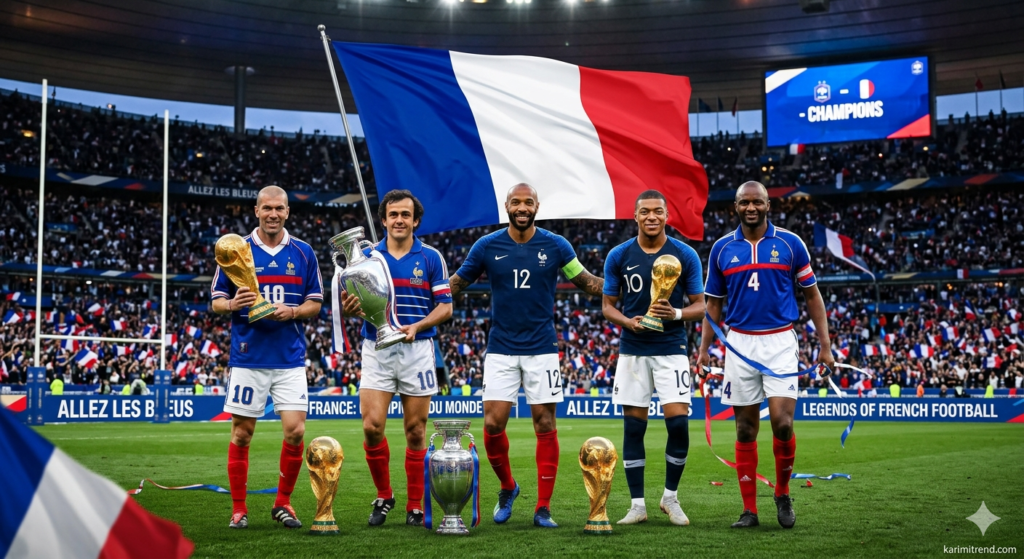
France has produced many of football’s greatest players.
1️⃣ Zinedine Zidane
- One of the greatest midfielders in history
- Star of the 1998 World Cup
Basic Information
- Full Name: Zinedine Yazid Zidane
- Date of Birth: 23 June 1972
- Place of Birth: Marseille, France
- Nationality: French
- Height: 1.85 m (6 ft 1 in)
- Position: Attacking Midfielder
- Nickname: Zizou
Club Career
AS Cannes (1989–1992)
Zidane started his professional football career with AS Cannes in France. Here he developed his technical skills and scored his first professional goal.
Girondins de Bordeaux (1992–1996)
At Bordeaux, Zidane became one of the most promising midfielders in Europe. His creativity and passing ability attracted the attention of major European clubs.
Juventus FC (1996–2001)
Zidane moved to the Italian giants Juventus and quickly became a world-class player.
Achievements with Juventus:
- 2× Serie A titles
- Multiple domestic trophies
- Reached the UEFA Champions League final
Real Madrid (2001–2006)
In 2001, Zidane joined Real Madrid for a world-record transfer fee at that time.
His most iconic moment came in the 2002 Champions League Final, where he scored a stunning volley goal that helped Real Madrid win the title.
Major achievements:
- 1× La Liga title
- 1× UEFA Champions League title
International Career – France
Zidane represented the France national football team from 1994 to 2006.
Major International Titles
- 1998 FIFA World Cup winner
- UEFA Euro 2000 winner
In the 1998 World Cup Final, Zidane scored two goals, leading France to their first World Cup victory.
Famous 2006 World Cup Incident
During the 2006 FIFA World Cup Final, Zidane famously head-butted Italian defender Marco Materazzi after a verbal exchange.
He received a red card, and the match became the final game of his professional career.
Individual Awards
- Ballon d’Or (1998)
- FIFA World Player of the Year (3 times)
- World Cup Golden Ball (2006)
- Numerous UEFA and international awards
Managerial Career
After retiring as a player, Zidane became a coach.
Real Madrid Manager (2016–2018, 2019–2021)
As a manager, he achieved historic success by winning three consecutive Champions League titles:
- UEFA Champions League 2016
- UEFA Champions League 2017
- UEFA Champions League 2018
No other manager had won the competition three times in a row in the modern era.
Career Statistics (Approximate)
Club Career
- Matches: 680+
- Goals: 120+
France National Team
- Matches: 108
- Goals: 31
2️⃣ Michel Platini
- One of Europe’s greatest players
- Won 3 Ballon d’Or awards
Basic Information
- Full Name: Michel François Platini
- Date of Birth: 21 June 1955
- Place of Birth: Jœuf, France
- Nationality: French
- Height: 1.79 m (5 ft 10 in)
- Position: Attacking Midfielder / Playmaker
Club Career
AS Nancy (1972–1979)
Platini began his professional career with AS Nancy in France.
Key achievement:
- Won the Coupe de France in 1978
- Became one of France’s most promising young midfielders.
AS Saint‑Étienne (1979–1982)
Platini joined one of France’s biggest clubs and helped them win:
- Ligue 1 title (1981)
His performances made him one of the top players in Europe.
Juventus FC (1982–1987)
Platini reached his peak at Juventus in Italy.
Major achievements:
- 2× Serie A titles
- UEFA Champions League winner
- Intercontinental Cup winner
- UEFA Cup Winners’ Cup winner
Platini was also the top scorer in Serie A three times, which is rare for a midfielder.
International Career – France
Platini played for the France national football team from 1976 to 1987.
Major Achievement
UEFA Euro 1984 Winner
- Platini scored 9 goals in the tournament, a record that still stands.
- He led France to their first major international trophy.
Individual Awards
Platini dominated world football in the 1980s.
- Ballon d’Or – 1983
- Ballon d’Or – 1984
- Ballon d’Or – 1985
He is one of the few players in history to win the Ballon d’Or three times in a row.
Career Statistics (Approximate)
Club Career
- Matches: 580+
- Goals: 310+
France National Team
- Matches: 72
- Goals: 41
These numbers are remarkable for a midfielder.
Leadership in Football Administration
After retiring from football, Platini moved into football leadership roles.
He served as President of
UEFA (2007–2015)
During this time he worked on expanding European competitions and developing football across Europe.
Legacy in Football
Michel Platini is remembered for:
- Brilliant vision and passing
- Goal-scoring midfielder
- Leadership for France in the 1980s
- Three consecutive Ballon d’Or awards
- One of the greatest European footballers ever
3️⃣ Thierry Henry
- France’s former all-time top scorer
- Famous for speed and finishing
Basic Information
- Full Name: Thierry Daniel Henry
- Date of Birth: 17 August 1977
- Place of Birth: Les Ulis, France
- Nationality: French
- Height: 1.88 m (6 ft 2 in)
- Position: Striker / Forward
Club Career
AS Monaco FC (1994–1999)
Henry began his professional career at Monaco under coach Arsène Wenger.
Achievements:
- Won the Ligue 1 title (1997)
- Developed into one of France’s most promising young players.
Juventus FC (1999)
Henry briefly played in Italy, but his time at Juventus was short and not very successful.
Arsenal F.C. (1999–2007)
Henry’s move to Arsenal transformed his career. Under Arsène Wenger, he became one of the best strikers in the world.
Major achievements:
- 2× **Premier League titles
- 3× **FA Cup titles
- Part of the legendary “Invincibles” team (2003–04 season)
Henry became Arsenal’s all-time top scorer with 228 goals.
FC Barcelona (2007–2010)
Henry joined Barcelona and became part of one of the greatest teams in football history.
Major trophies:
- UEFA Champions League (2009)
- La Liga titles
- FIFA Club World Cup
Barcelona completed a historic treble in 2009.
New York Red Bulls (2010–2014)
Henry ended his career in Major League Soccer in the United States and became one of the league’s biggest stars.
International Career – France
Henry played for the France national football team from 1997 to 2010.
Major achievements:
- 1998 FIFA World Cup winner
- UEFA Euro 2000 winner
Henry is also one of the top scorers in France national team history.
Career Statistics (Approximate)
Club Career
- Matches: 790+
- Goals: 360+
France National Team
- Matches: 123
- Goals: 51
Individual Awards
- Premier League Golden Boot – 4 times
- European Golden Boot (2 times)
- Multiple FIFA and UEFA team awards
Henry was also twice runner-up for the Ballon d’Or.
Style of Play
Thierry Henry was famous for:
- Incredible speed and acceleration
- Precise finishing
- Curved shots into the far corner
- Dribbling from the left side into the center
- Excellent passing and creativity
4️⃣ Kylian Mbappé
- One of the best modern players
- Scored hat-trick in the 2022 World Cup Final
Basic Information
- Full Name: Kylian Mbappé Lottin
- Date of Birth: 20 December 1998
- Place of Birth: Bondy, France
- Nationality: French
- Height: 1.78 m (5 ft 10 in)
- Position: Forward / Winger
- Nickname: Donatello (early career), “KM7”
Club Career
AS Monaco FC (2015–2017)
Mbappé began his professional career at Monaco. He quickly became a breakout star for the team. Real Madrid Club de Football
Achievements:
- Ligue 1 title (2016–17)
- UEFA Champions League semi-finalist (2017)
- Scored 26 goals in 44 appearances during the title-winning season
Paris Saint-Germain (2017–Present)
Mbappé joined PSG initially on loan and then permanently in a world-record transfer deal for a teenager.
Major Achievements:
- Multiple Ligue 1 titles
- Multiple Coupe de France titles
- UEFA Champions League runner-up (2020)
- Over 200 goals in all competitions for PSG
Style: Known for blistering pace, skillful dribbling, and lethal finishing in the box.
International Career – France
Mbappé became a star for France national football team from a very young age.
Major Achievements:
- 2018 FIFA World Cup winner
- Scored 4 goals in the tournament
- Became the second teenager in history (after Pelé) to score in a World Cup final
- UEFA Euro 2020 participant
- Key figure in France’s 2022 World Cup qualifying and campaigns
Career Statistics (Approximate)
Club Career (Monaco + PSG):
- Matches: 340+
- Goals: 240+
France National Team:
- Matches: 80+
- Goals: 40+
Individual Awards
- Ligue 1 Player of the Year – multiple times
- Golden Boy Award – 2017
- FIFA World Cup Best Young Player – 2018
- Multiple top scorer awards in Ligue 1
Style of Play
Mbappé is known for:
- Exceptional acceleration and top speed
- Excellent dribbling and ball control
- Clinical finishing with both feet
- Intelligent positioning and movement off the ball
- Ability to play as striker, winger, or second striker
Legacy and Impact
Kylian Mbappé is considered:
- One of the fastest players in football history
- A generational talent of France’s golden generation
- Future contender for multiple Ballon d’Or awards
- Modern football icon, combining skill, speed, and consistency
5️⃣ Patrick Vieira
- Legendary midfielder and captain
Basic Information
- Full Name: Patrick Vieira
- Date of Birth: 23 June 1976
- Place of Birth: Dakar, Senegal
- Nationality: French
- Height: 1.93 m (6 ft 4 in)
- Position: Defensive Midfielder / Central Midfielder
- Nickname: “Vieri” or “The General”
Club Career
AS Cannes (1993–1995)
Vieira began his professional career in France at AS Cannes, developing his skills as a box-to-box midfielder.
AC Milan (1995–1996)
Vieira moved to Italy’s AC Milan, but had limited playing time.
Arsenal F.C. (1996–2005)
Vieira joined Arsenal under Arsène Wenger and became team captain, leading the club during one of its most successful eras.
Achievements:
- 3× Premier League titles
- 4× FA Cup titles
- Part of the legendary “Invincibles” team (2003–04 season, unbeaten all season)
Style: Powerful, dominant in tackles, excellent passer, and strong leader.
Juventus FC (2005–2006)
Vieira had a short spell at Juventus in Italy, adding experience to his career.
Inter Milan (2006–2010)
Vieira won multiple Serie A titles under coach José Mourinho, further cementing his reputation as a complete midfielder.
Manchester City (2010–2011)
Vieira finished his playing career at Manchester City in the Premier League.
International Career – France
Vieira played for the France national football team from 1997 to 2009.
Major Achievements:
- 1998 FIFA World Cup winner
- UEFA Euro 2000 winner
- FIFA Confederations Cup winner
- Key player in France’s golden generation alongside Zidane, Henry, and Deschamps
Career Statistics (Approximate)
Club Career:
- Matches: 650+
- Goals: 50+
France National Team:
- Matches: 107
- Goals: 6
Individual Awards
- PFA Team of the Year (Premier League) – multiple times
- Premier League Player of the Month awards
- UEFA Euro Team of the Tournament – 2000
Style of Play
Patrick Vieira was known for:
- Dominating midfield battles
- Powerful tackling and interception
- Intelligent positioning and game control
- Leadership as Arsenal captain
- Versatility: defensive and box-to-box roles
Legacy
Patrick Vieira is remembered as:
- One of Premier League’s greatest midfielders
- Arsenal’s legendary captain and “Invincible” leader
- Integral part of France’s World Cup and Euro-winning teams
- A role model for midfield dominance and leadership
Home Stadium
France usually plays its home matches at:
Stade de France
Capacity: 80,000+
It is the largest stadium in France and hosted the 1998 World Cup Final.
Famous Coaches
Didier Deschamps
- Former World Cup-winning captain (1998)
- Coach of the 2018 World Cup winning team
Aimé Jacquet
- Manager of the 1998 World Cup champions
Current France National Team (Modern Era)
France currently has one of the strongest squads in world football.
Key Players
⭐ Kylian Mbappé – Captain and superstar
⭐ Antoine Griezmann – Playmaker
⭐ Olivier Giroud – Top striker
⭐ Aurélien Tchouaméni – Midfielder
⭐ Eduardo Camavinga – Young star
⭐ Theo Hernández – Defender
⭐ Mike Maignan – Goalkeeper
Major Achievements
France has won several major trophies:
2 FIFA World Cups – 1998, 2018
2 UEFA European Championships – 1984, 2000
2 FIFA Confederations Cups – 2001, 2003
UEFA Nations League – 2021
Records
- Top Goalscorer: Olivier Giroud
- Most Appearances: Hugo Lloris
- Young superstar: Kylian Mbappé
Famous Rivalries
France has strong rivalries with:
- Germany national football team
- Italy national football team
- England national football team
These matches are among the most exciting games in international football.
3- Brazil national football team
The Brazil national football team, also known as Seleção, is one of the most successful and iconic football teams in history. Famous for its attacking style, technical skill, and legendary players, Brazil has been a dominant force in international football for decades.
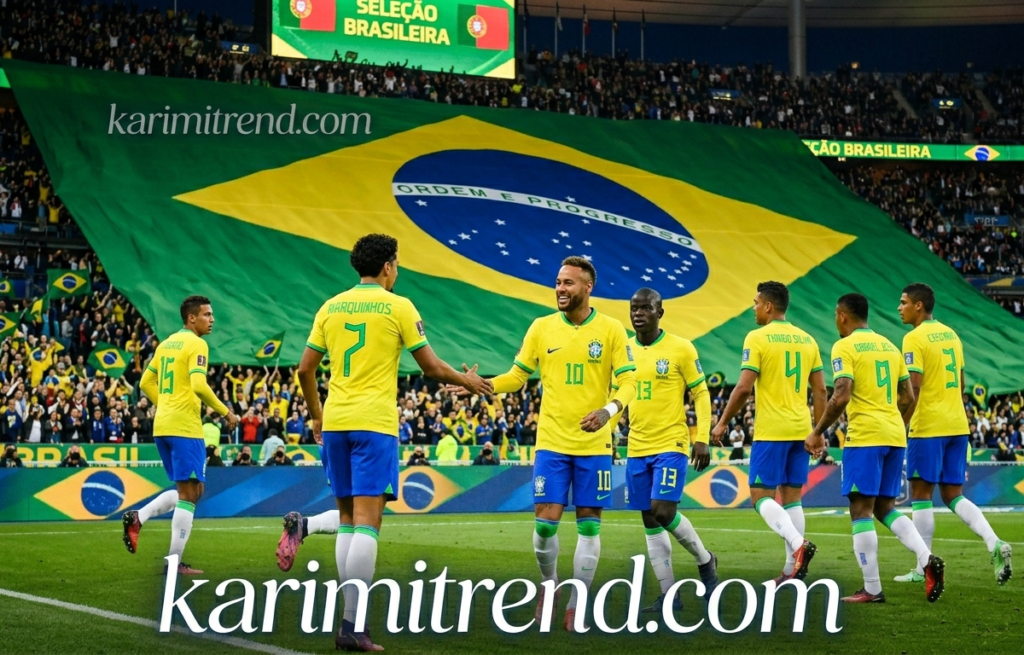
Basic Information
- Country: Brazil
- Nickname: Seleção (The Selection), Canarinha (Little Canary)
- Confederation: CONMEBOL (South America)
- Head Coach: Fernando Diniz (as of 2026)
- Captain: Neymar Jr
- Home Stadium: Maracanã Stadium, Rio de Janeiro, Brazil
History
Early Years
The Brazil national team played its first official match in 1914 against Argentina. Brazil quickly became a powerhouse in South American football.
Rise to Global Dominance
- 1958 FIFA World Cup – 1st World Cup win in Sweden
- 1962 FIFA World Cup – Champions in Chile
- 1970 FIFA World Cup – Legendary team featuring Pelé
- Style: Beautiful, attacking football known as “Joga Bonito”
FIFA World Cup Records
Brazil is the most successful national team in World Cup history:
- Total Titles: 5
- 1958 (Sweden)
- 1962 (Chile)
- 1970 (Mexico)
- 1994 (USA)
- 2002 (South Korea/Japan)
- Runners-up: 2 (1950, 1998)
- Third Place: 2 (1938, 1978)
- FIFA World Cup Appearances: 22/22 (Qualified for every tournament)
Copa América Records
- Titles: 9
- Runners-up: 12+
- Brazil has always been one of the strongest teams in South America.
Confederations Cup
- Titles: 4 (1997, 2005, 2009, 2013)
- Runners-up: 1
Style of Play
Brazil is famous for:
- Attacking, skillful, and creative football (Joga Bonito)
- Flair, dribbling, and individual talent
- Strong midfield control and fast counterattacks
- Legendary attacking formations (4-2-4, 4-3-3)
Legendary Players
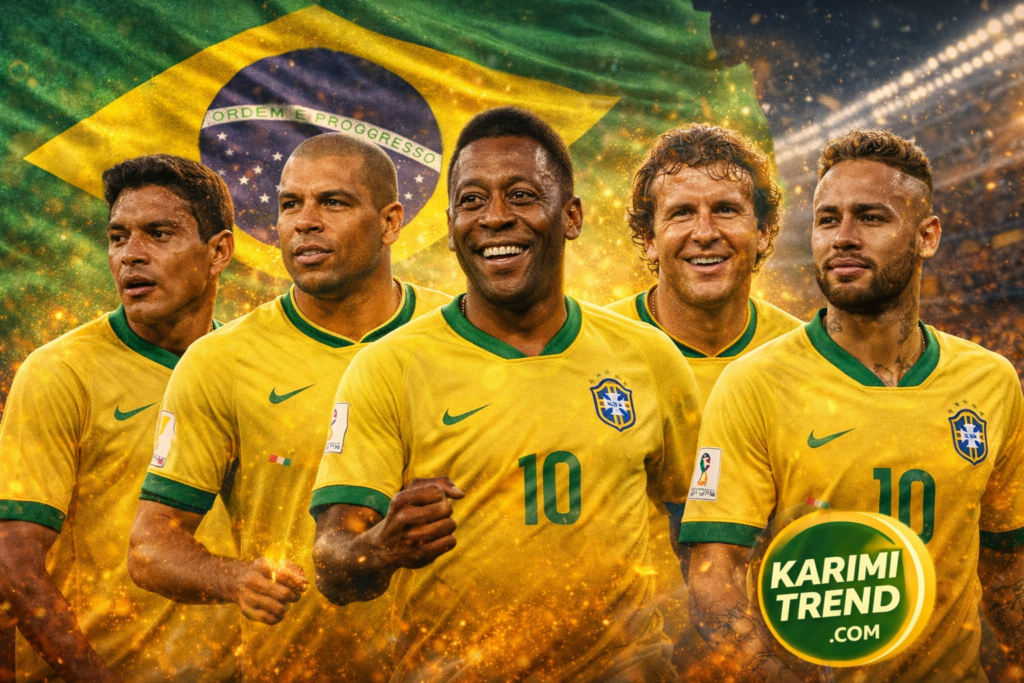
Historic Icons:
- Pelé – World Cup winner, considered the greatest player ever
- Zico – Midfield maestro of the 1970s-80s
- Ronaldo Nazário – Striker and World Cup winner
- Ronaldinho – Magic, dribbling, and flair
- Cafu – Legendary captain and fullback
Modern Stars:
- Neymar Jr – Current captain and superstar
- Vinícius Júnior – Fast winger
- Alisson Becker – Goalkeeper
Records & Achievements
- Most World Cups: 5 (most in history)
- Most World Cup Goals: Marta (women’s), Ronaldo (men’s)
- Most Consecutive Wins: 12 (record in international matches)
- FIFA Rankings: Frequently top 5 in the world
Home Stadium
Maracanã Stadium, Rio de Janeiro:
- One of the world’s most iconic stadiums
- Capacity: 78,838
- Hosted 1950 and 2014 FIFA World Cup finals
Key Facts
- Brazil is the only team to have played in every World Cup
- Known for producing legendary talent every generation
- National colors: Yellow jersey, blue shorts, white socks
- Known for iconic celebrations and samba-inspired style
Legacy
The Brazil national football team is:
- Symbol of football artistry
- Most successful men’s team in World Cup history
- A global football powerhouse with legendary players
- Known for entertaining and attacking football loved worldwide
Top 5 Greatest Players in Brazil
i) Pelé
Pelé is widely regarded as the greatest football player of all time. His full name is Edson Arantes do Nascimento, and he became a global icon for his incredible skill, goal-scoring ability, and influence on the game.
Basic Information
- Full Name: Edson Arantes do Nascimento
- Date of Birth: 23 October 1940
- Place of Birth: Três Corações, Brazil
- Nationality: Brazilian
- Height: 1.73 m (5 ft 8 in)
- Position: Forward / Attacking Midfielder
- Nickname: Pelé
Club Career
Santos FC (1956–1974)
Pelé spent most of his career at Santos FC, where he became a legend.
Achievements with Santos:
- 6× Campeonato Paulista titles
- 2× Copa Libertadores titles (1962, 1963)
- 2× Intercontinental Cup winner
- Scored 643 goals in 659 official matches for Santos
- Known for amazing dribbling, finishing, and free-kicks
New York Cosmos (1975–1977)
Pelé ended his career in the North American Soccer League (NASL) with New York Cosmos.
- Helped popularize football in the USA
- Scored 37 goals in 64 matches
- Became a global ambassador for the sport
International Career – Brazil
Pelé played for the Brazil national football team from 1957 to 1971.
World Cup Achievements:
- 1958 FIFA World Cup – Winner at age 17, scored 6 goals
- 1962 FIFA World Cup – Winner, scored 4 goals before injury
- 1970 FIFA World Cup – Winner, captain, 4 goals, iconic for the perfect Brazil team
Total Goals for Brazil: 77 goals in 92 matches
Famous Moments:
- Hat-trick in the 1958 World Cup semifinal against France
- Two goals in the 1958 final against Sweden
- Iconic 1970 World Cup performance with a 1–0 goal vs Uruguay in the final
Style of Play
Pelé was known for:
- Incredible goal-scoring instincts
- Amazing dribbling and flair
- Powerful and accurate shooting with both feet
- Strong aerial ability despite average height
- Creativity and vision as a playmaker
Records & Achievements
- Most Career Goals: 1,281 goals in 1,363 games (official + unofficial)
- Youngest World Cup Winner: 17 years old in 1958
- 3× FIFA World Cup Winner (1958, 1962, 1970) – only player in history
- FIFA Player of the Century (shared with Diego Maradona)
- Named in FIFA 100 Greatest Living Players
Legacy
Pelé is remembered as:
- The “King of Football”
- A global ambassador of the sport
- Pioneer of attacking, beautiful football (Jogo Bonito)
- An inspirational figure for millions of footballers worldwide
ii) Ronaldo Nazário – Complete Details
Ronaldo Luís Nazário de Lima, commonly known as Ronaldo or “O Fenômeno” (The Phenomenon), is considered one of the greatest strikers of all time. Known for his explosive pace, dribbling, and clinical finishing, he dominated world football in the late 1990s and early 2000s.
Basic Information
- Full Name: Ronaldo Luís Nazário de Lima
- Date of Birth: 18 September 1976
- Place of Birth: Rio de Janeiro, Brazil
- Nationality: Brazilian
- Height: 1.83 m (6 ft 0 in)
- Position: Striker / Forward
- Nickname: O Fenômeno
Club Career
Cruzeiro (1993–1994)
Ronaldo began his professional career in Brazil with Cruzeiro, showing incredible talent at just 16 years old.
- Goals: 44 goals in 47 matches
- Attracted attention from top European clubs
PSV Eindhoven (1994–1996)
Moved to PSV in the Netherlands, where he became a prolific goal-scorer.
- Goals: 54 goals in 57 appearances
- Established himself as one of the world’s top young talents
FC Barcelona (1996–1997)
Ronaldo spent one spectacular season at Barcelona.
- Goals: 47 goals in 49 matches
- Won Copa del Rey, UEFA Cup Winners’ Cup, and Super Cup
- Became a global superstar
Inter Milan (1997–2002)
Ronaldo transferred to Italy, where he was known as “Il Fenomeno”.
- Serie A top scorer in 1997–98
- Won UEFA Cup (1998)
- Suffered major knee injuries, missing significant playing time
Real Madrid (2002–2007)
Part of the famous Galácticos era.
- Won 2× La Liga titles
- Won 2002–03 UEFA Champions League
- Scored 104 goals in 177 appearances
AC Milan (2007–2008)
Short spell in Italy with Milan, struggled with injuries.
Corinthians (2009–2011)
Returned to Brazil to finish his career with Corinthians.
- Won the Brazilian Championship
- Retired in 2011 as one of the greatest forwards ever
International Career – Brazil
Ronaldo played for the Brazil national football team from 1994 to 2011.
World Cup Achievements:
- 1994 FIFA World Cup – Squad member (did not play)
- 1998 FIFA World Cup – Runner-up, scored 4 goals
- 2002 FIFA World Cup – Winner, scored 8 goals (Golden Boot)
- 2006 FIFA World Cup – 3 goals, Brazil’s top scorer
Total Goals for Brazil: 62 goals in 98 matches
Famous Moments:
- Hat-trick against Costa Rica in 2002 World Cup
- Two goals in 2002 World Cup final vs Germany
- Dominant performances at the 1998 World Cup despite injury
Style of Play
Ronaldo was famous for:
- Explosive acceleration and pace
- Exceptional dribbling and close control
- Clinical finishing with both feet
- Ability to beat multiple defenders in one run
- Excellent positioning and football intelligence
Records & Achievements
- 2× FIFA World Cup winner (1994, 2002)
- FIFA World Cup Golden Ball (1998)
- FIFA World Cup Golden Boot (2002)
- 3× FIFA World Player of the Year (1996, 1997, 2002)
- 4× top scorer in major European leagues
- Included in FIFA 100 Greatest Living Players
Legacy
Ronaldo is remembered as:
- One of the greatest strikers of all time
- A player who defined the modern forward role
- Iconic in both club and international football
- “O Fenômeno” – a symbol of Brazilian attacking excellence
iii) Ronaldinho
Ronaldo de Assis Moreira, known worldwide as Ronaldinho, is one of football’s most skillful and entertaining players. Famous for his dribbling, flair, creativity, and magical free-kicks, Ronaldinho became a global icon of Brazilian football and won multiple trophies at club and international level.
Basic Information
- Full Name: Ronaldo de Assis Moreira
- Date of Birth: 21 March 1980
- Place of Birth: Porto Alegre, Brazil
- Nationality: Brazilian
- Height: 1.81 m (5 ft 11 in)
- Position: Attacking Midfielder / Winger
- Nickname: Ronaldinho Gaúcho
Club Career
Grêmio (1998–2001)
Ronaldo began his professional career at Grêmio, showcasing his extraordinary dribbling skills and technique.
Achievements:
- Helped Grêmio reach Brazilian league finals
- Attracted attention from top European clubs
Paris Saint-Germain (2001–2003)
Ronaldo moved to PSG in France and quickly became one of the league’s standout players.
- Known for dazzling dribbles and creativity
- Won UNFP Ligue 1 Young Player of the Year
FC Barcelona (2003–2008)
His peak years came at Barcelona, where he became a world superstar.
Major Achievements:
- 2× La Liga titles (2004–05, 2005–06)
- UEFA Champions League winner (2005–06)
- FIFA World Player of the Year – 2004, 2005
- Famous for bicycle kicks, no-look passes, and long-range free-kicks
AC Milan (2008–2011)
Ronaldo moved to Italy later in his career and won the Serie A title with Milan.
Other Clubs
- Played briefly for Flamengo and Atlético Mineiro in Brazil before retiring.
International Career – Brazil
Ronaldo played for the Brazil national football team from 1999 to 2013.
Major Achievements:
- 2002 FIFA World Cup – Winner, scored 2 goals in the final vs Germany
- Copa América: 1999 winner
- FIFA Confederations Cup: 2005 winner
- Known for incredible dribbling and creating chances for teammates
Goals for Brazil: 33 goals in 97 matches
Style of Play
Ronaldo was famous for:
- Extraordinary dribbling and ball control
- Creative passes and flair plays
- Free-kick mastery
- Vision and technique to unlock defenses
- Attacking versatility as winger or central midfielder
Records & Achievements
- 2× FIFA World Player of the Year (2004, 2005)
- FIFA World Cup Golden Ball – 2002
- UEFA Champions League winner (2006)
- La Liga top scorer – 2005–06 season
- Part of the FIFA 100 Greatest Living Players
Legacy
Ronaldinho is remembered as:
- One of the most skillful and entertaining players ever
- Master of “Joga Bonito” – the beautiful game
- Inspired a generation of footballers with his dribbling and creativity
- Global football ambassador and cultural icon
iv) Cafu – Complete Details
Cafu, full name Marcos Evangelista de Morais, is regarded as one of the greatest right-backs in football history. Known for his stamina, speed, attacking runs, and leadership, Cafu was a key figure for both Brazil national football team and club teams like AS Roma and AC Milan.
Basic Information
- Full Name: Marcos Evangelista de Morais
- Date of Birth: 7 June 1970
- Place of Birth: São Paulo, Brazil
- Nationality: Brazilian
- Height: 1.76 m (5 ft 9 in)
- Position: Right Back / Defender
- Nickname: Cafu
Club Career
São Paulo FC (1989–1995)
Cafu began his professional career at São Paulo FC, becoming known for his attacking runs from defense.
Achievements:
- 2× Copa Libertadores winner (1992, 1993)
- Intercontinental Cup winner (1992, 1993)
Real Zaragoza (1995–1996)
Brief spell in Spain, gaining European experience before moving to Italy.
AS Roma (1997–2003)
Cafu became one of the best full-backs in Europe at Roma.
Achievements:
- Serie A title – 2000–01
- Known for endless energy, overlapping runs, and precise crosses
AC Milan (2003–2008)
Cafu moved to Milan and won multiple trophies.
Achievements:
- UEFA Champions League winner – 2006–07
- Serie A title – 2003–04
- FIFA Club World Cup winner
- Served as captain in later years
International Career – Brazil
Cafu is Brazil’s most-capped player with 142 appearances.
Major Achievements:
- 1994 FIFA World Cup – Winner
- 1998 FIFA World Cup – Runner-up
- 2002 FIFA World Cup – Winner, captain
- Copa América: 1997, 1999 winner
- FIFA Confederations Cup: 1997, 2005 winner
Style: Known for attacking full-back role, stamina, and leadership
Style of Play
Cafu was famous for:
- Exceptional pace and stamina, could run the whole flank
- Overlapping runs and accurate crosses
- Defensive reliability and tactical intelligence
- Leadership as Brazil and club captain
- Versatility in both attack and defense
Records & Achievements
- Most capped Brazilian player – 142 appearances
- 2× FIFA World Cup winner (1994, 2002)
- 1× World Cup runner-up (1998)
- UEFA Champions League winner (2007)
- Named in FIFA 100 Greatest Living Players
Legacy
Cafu is remembered as:
- One of the best right-backs in football history
- Legendary leader and captain of Brazil
- Pioneer of the modern attacking full-back role
- A symbol of professionalism, stamina, and consistency
v) Zico
Arthur Antunes Coimbra, popularly known as Zico, is one of Brazil’s greatest footballers and a legendary attacking midfielder. Known as the “White Pelé”, Zico was famous for his vision, technique, dribbling, and free-kick mastery. He is considered one of the best playmakers in football history.
Basic Information
- Full Name: Arthur Antunes Coimbra
- Date of Birth: 3 March 1953
- Place of Birth: Rio de Janeiro, Brazil
- Nationality: Brazilian
- Height: 1.72 m (5 ft 8 in)
- Position: Attacking Midfielder
- Nickname: Zico, White Pelé
Club Career
Flamengo (1971–1983, 1985–1989)
Zico is most closely associated with Flamengo, where he became a club legend.
Achievements:
- 4× **Campeonato Brasileiro Série A titles
- 2× Copa Libertadores winner (1981)
- Intercontinental Cup winner (1981, defeating Liverpool)
- Total Goals: 508 in 731 matches for Flamengo
Udinese (1983–1985)
Zico had a brief spell in Italy with Udinese, showcasing his skill in Serie A.
Other Clubs
- Kashima Antlers (Japan) – Played and later coached, helping develop football in Asia
International Career – Brazil
Zico played for the Brazil national football team from 1976 to 1986.
Major Achievements:
- Copa América runner-up – 1979
- FIFA World Cup – 1978, 1982, 1986 (notably led the 1982 “beautiful team” that dazzled the world)
- Goals for Brazil: 48 goals in 71 matches
Famous Moments:
- Master of free-kicks and penalties
- Key player in the 1982 World Cup team, often regarded as one of the most skillful Brazilian squads ever
Style of Play
Zico was famous for:
- Exceptional vision and passing ability
- Precise shooting and free-kicks
- Dribbling and creativity in the attacking midfield
- Leadership on and off the pitch
- Ability to control tempo and dictate play
Records & Achievements
- FIFA World Cup top scorer for Brazil (1982, 4 goals)
- Multiple South American Footballer of the Year nominations
- Brazilian Football Museum Hall of Fame
- Considered one of the best playmakers in football history
Legacy
Zico is remembered as:
- The “White Pelé” for his skill and impact
- One of Brazil’s greatest attacking midfielders
- A symbol of elegant, technical football
- Influential in developing football in Japan as a player and coach
4- England national football team
The England national football team is the official football team representing England in international football. Known for its rich history, passionate fans, and historic stadium, Wembley Stadium, England is one of the oldest football nations in the world.
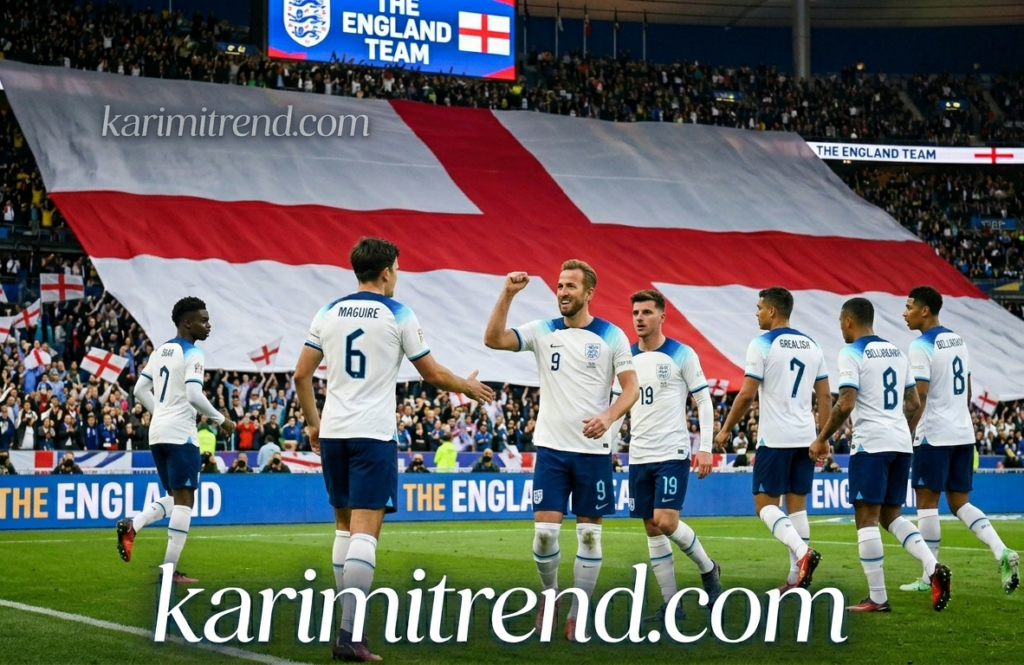
The team is governed by the The Football Association (FA) and competes in tournaments like the FIFA World Cup, UEFA European Championship, and UEFA Nations League.
History and Origins
- England played the world’s first official international match against Scotland national football team on 30 November 1872, ending in a 0-0 draw.
- Known as the Three Lions, England has been a pioneer in football development, influencing modern football tactics and the spread of the game globally.
- England is part of UEFA, representing Europe in international competitions.
World Cup Record
The England national football team has a long history in the FIFA World Cup, achieving notable milestones:
- 1966 FIFA World Cup champions – Hosted in England, beat West Germany 4-2 in the final
- Semi-final appearances: 1990, 2018
- Quarter-final appearances: multiple (1998, 2002, 2006, 2014)
- England is known for producing world-class forwards, midfielders, and defenders, with legendary players performing in top leagues across Europe.
UEFA European Championship
- England has reached the final of the UEFA Euro 2020, losing to Italy on penalties.
- Consistently competitive in UEFA European Championship tournaments, often reaching quarter-finals or semi-finals.
- The team is known for its resilient defense, tactical discipline, and clinical finishing in European competitions.
Home Stadium – Wembley
- Wembley Stadium is England’s national stadium, located in London.
- Capacity: 90,000+ spectators, hosting home matches, FA Cup finals, and international friendlies.
- Wembley is symbolic of England’s football culture and is central to national pride and historic matches.
Legendary Players
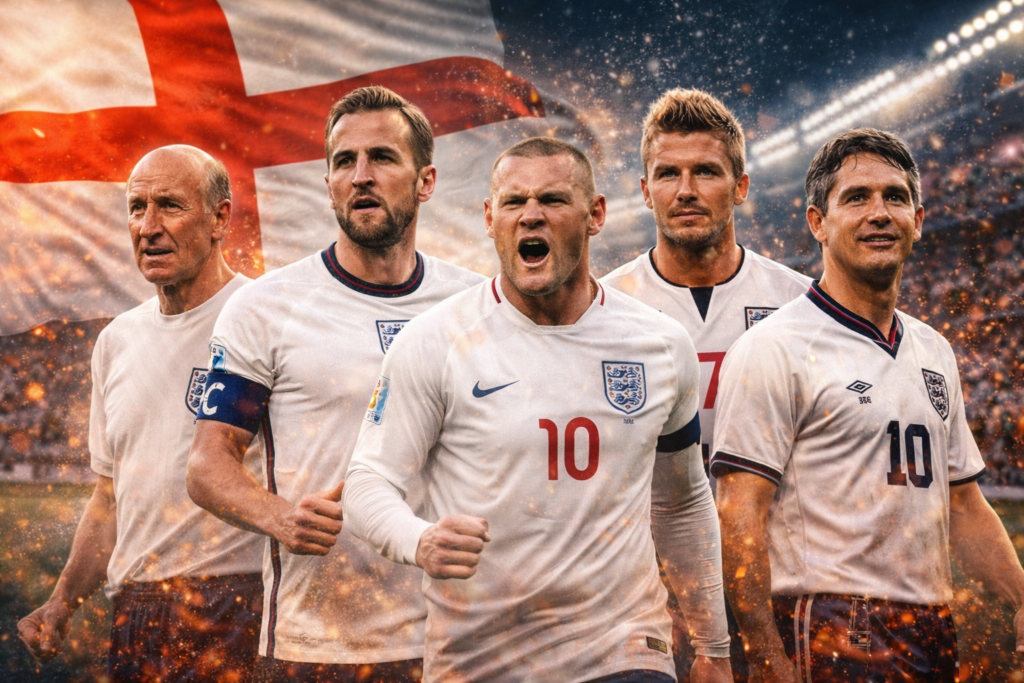
England has produced some of the most iconic footballers in history:
- Bobby Charlton – 1966 World Cup hero, midfield legend
- Gary Lineker – 1986 World Cup Golden Boot winner
- David Beckham – Free-kick specialist, global icon
- Wayne Rooney – England’s all-time top scorer
- Harry Kane – Current captain, prolific striker
Playing Style
- Historically known for strong defense, aerial power, and long-ball tactics
- Modern England emphasizes possession, high pressing, and tactical versatility under current managers
- Known for producing fast wingers, clinical forwards, and disciplined midfielders
Achievements & Records
- FIFA World Cup: Champions 1966, multiple semi-finalists
- UEFA Euro: Runners-up 2020
- UEFA Nations League: Semi-finalists 2019
- Produces players who succeed in Premier League, La Liga, Serie A, Bundesliga
- Recognized for having one of the strongest football infrastructures and youth academies in the world
Legacy and Impact
The England national football team is not just a team but a symbol of national pride and football heritage:
- One of the oldest football teams in the world
- Contributed significantly to modern football rules and style
- Inspires millions of fans globally through historic matches, legendary players, and competitive tournaments
Top 5 best football players of ENGLAND
1️⃣ Bobby Charlton
Complete Details
Bobby Charlton was one of the greatest footballers in English history. He was born on 11 October 1937 in England and played mainly as an attacking midfielder and forward. Charlton is best remembered for his leadership, powerful long-range shots, and incredible consistency throughout his career. He became a symbol of English football excellence and is widely respected around the world.
Charlton played almost his entire club career for Manchester United from 1956 to 1973. During his time at the club, he made 758 appearances and scored 249 goals. He helped Manchester United win multiple league titles and the prestigious European Cup in 1968. One of the most important moments in his life was surviving the 1958 Munich Air Disaster, after which he became a key leader of the team and helped rebuild the club into a European champion side.
England National Team Career
Bobby Charlton had an outstanding international career with the England national team. He made his debut in 1958 and represented England until 1970. In total, he played 106 matches and scored 49 goals, making him one of England’s top scorers for many years. He played in three FIFA World Cups (1962, 1966, and 1970). His biggest achievement came in 1966 when he helped England win the FIFA World Cup on home soil. That victory remains the greatest moment in English football history.
Charlton was also known for his leadership and professionalism. He won the Ballon d’Or in 1966, which is awarded to the best player in the world. In addition, he was later knighted and became known as Sir Bobby Charlton, showing how much he contributed to football and his country.
Career Statistics Tables
England Career Stats
| Category | Details |
|---|---|
| Matches Played | 106 |
| Goals Scored | 49 |
| Playing Years | 1958–1970 |
| World Cups Played | 3 |
| World Cup Winner | 1966 |
| Average Goals per Game | 0.46 |
Club Career Stats (Manchester United)
| Category | Details |
|---|---|
| Club | Manchester United |
| Matches Played | 758 |
| Goals Scored | 249 |
| Playing Years | 1956–1973 |
| Major Achievement | European Cup Winner (1968) |
Playing Style & Legacy
Bobby Charlton was famous for his powerful shots from distance, excellent vision, accurate passing, and strong leadership qualities. He was a complete attacking midfielder who could score goals and also create opportunities for teammates. His impact on English football is unforgettable, and he is considered one of the greatest legends in the history of the sport.
2️⃣ Wayne Rooney 🇬🇧
Complete Details
Wayne Rooney is one of the greatest English footballers of the modern era. He was born on 24 October 1985 in Liverpool, England. Rooney was known for his incredible strength, determination, technical ability, and versatility. He could play as a striker, attacking midfielder, or even in deeper midfield roles. His aggressive playing style and powerful shooting made him one of the most dangerous forwards in world football during his peak years.
Rooney became famous at a very young age when he started his professional career with Everton. Later, he joined Manchester United in 2004, where he became a club legend. During his time at Manchester United, he won multiple Premier League titles, domestic cups, and the UEFA Champions League. He formed a strong attacking partnership with players like Cristiano Ronaldo and helped the team dominate English football for many years.
England National Team Career
Wayne Rooney had an outstanding international career with the England national team. He made his debut in 2003 at just 17 years old, becoming one of the youngest players to represent England. Over his international career, he played 120 matches and scored 53 goals, making him England’s all-time leading goal scorer. He played in several major tournaments including the UEFA European Championship and FIFA World Cups (2006, 2010, 2014).
Rooney also served as England captain and was known for his leadership on the field. His ability to score goals, create chances, and contribute in different positions made him extremely valuable for the national team.
Club Career Overview
Rooney played for:
- Everton (early career and return later in career)
- Manchester United (2004–2017)
- D.C. United (USA)
- Later managed and coached in football after retirement
At Manchester United, he became the club’s all-time top scorer for many years, scoring 253 goals in all competitions. He helped the club win major trophies including league titles and the Champions League.
Career Statistics Tables
England Career Stats
| Category | Details |
|---|---|
| Matches Played | 120 |
| Goals Scored | 53 |
| Goals Record | England All-Time Top Scorer |
| Playing Years | 2003–2018 |
| Major Tournaments | World Cups & European Championships |
Club Career (Major Highlights)
| Club | Matches (Approx.) | Goals (Approx.) | Key Achievements |
|---|---|---|---|
| Manchester United | 500+ | 253 | Premier League Titles, Champions League |
| Everton | Multiple spells | Key goals | Breakthrough club |
| D.C. United | MLS Career | Experienced leader | International experience |
Playing Style & Strengths
Wayne Rooney was famous for:
- Physical strength
- Powerful long-range shooting
- High work rate
- Versatility (striker & midfielder)
- Game intelligence
- Leadership qualities
He was not only a goal scorer but also a playmaker who could assist teammates and control the game from midfield.
Legacy
Wayne Rooney is considered one of the greatest English players in history. His records for England and Manchester United show his consistency and impact at the highest level. Even after retirement, he remains an important figure in English football as a coach and football personality.
3️⃣ David Beckham
Complete Details
David Beckham is one of the most famous football players in the world. He was born on 2 May 1975 in London, England. Beckham was widely known for his exceptional free-kick ability, accurate crossing, leadership qualities, and professionalism. He became a global football icon not only because of his skills on the field but also due to his influence off the field.
Beckham started his professional career with Manchester United, where he became one of the key players in the legendary team managed by Sir Alex Ferguson. During his time at Manchester United (1992–2003), he won multiple Premier League titles, FA Cups, and the UEFA Champions League in 1999, achieving the famous treble. He was known for his perfect long passes, precise crosses, and powerful free kicks that often changed the outcome of matches.
After leaving Manchester United, Beckham played for some of the biggest clubs in the world, including Real Madrid, where he played alongside world-class players in the famous “Galácticos” era. Later, he moved to the United States and joined LA Galaxy, helping grow football’s popularity in America. He also had loan spells at AC Milan and later ended his playing career at Paris Saint-Germain.
International Career (England)
David Beckham represented the England national team for many years. He made his debut in 1996 and played until 2009. During his international career, he earned 115 caps and scored 17 goals for England. He participated in major tournaments including the FIFA World Cups (1998, 2002, 2006) and UEFA European Championships.
Beckham also served as England captain from 2000 to 2006. He was respected for his leadership, determination, and ability to perform under pressure. One of his most memorable moments was scoring crucial free-kick goals in important matches, helping England qualify for tournaments.
Career Statistics Tables
England Career Stats
| Category | Details |
|---|---|
| Matches Played | 115 |
| Goals Scored | 17 |
| Playing Years | 1996–2009 |
| World Cups Played | 3 |
| Captaincy | 2000–2006 |
Club Career Highlights
| Club | Years | Major Achievements |
|---|---|---|
| Manchester United | 1992–2003 | Premier League Titles, Champions League (1999) |
| Real Madrid | 2003–2007 | La Liga Title |
| LA Galaxy | 2007–2012 | MLS Cups |
| AC Milan (Loan) | 2009–2010 | Experience in Serie A |
| Paris Saint-Germain | 2013 | League Title |
Playing Style & Strengths
David Beckham was famous for:
- World-class free kicks
- Accurate long-range passing
- Excellent crossing ability
- Game intelligence
- Leadership skills
- Global influence
His set-piece accuracy was considered among the best in football history. He could deliver perfect crosses that created many goal-scoring opportunities for teammates.
Legacy
Beckham is not only remembered as a talented footballer but also as a global sports ambassador. He helped popularize football worldwide, especially in the United States. His professionalism and dedication made him one of the most respected players in modern football.
4️⃣ Steven Gerrard
Complete Details
Steven Gerrard is considered one of the greatest midfielders in English football history. He was born on 30 May 1980 in Whiston, England. Gerrard was famous for his powerful long-range goals, incredible stamina, passing ability, and strong leadership qualities. He was a complete box-to-box midfielder who could defend, attack, and control the tempo of the game.
Gerrard spent the majority of his club career at Liverpool FC, where he became a club legend and captain. He played for Liverpool from 1998 to 2015. During his time at the club, he scored many important goals and led the team in some of their greatest victories. His leadership and passion made him a fan favorite at Anfield.
One of the biggest achievements of his career was winning the UEFA Champions League in 2005. In the famous final against AC Milan, Liverpool made a historic comeback after being 3–0 down, and Gerrard played a key role in inspiring the team. That match is known as one of the greatest finals in football history. He also won domestic trophies like the FA Cup, League Cup, and UEFA Super Cup with Liverpool.
England National Team Career
Steven Gerrard represented the England national team from 2000 to 2014. He earned 114 caps and scored 21 goals for England. He played in multiple major tournaments, including the FIFA World Cups (2006, 2010, 2014) and UEFA European Championships.
Gerrard served as England captain and was respected for his determination and leadership on the international stage. Although England did not win major tournaments during his time, he consistently performed at a high level and was one of the most important players in the squad.
Career Statistics Tables
England Career Stats
| Category | Details |
|---|---|
| Matches Played | 114 |
| Goals Scored | 21 |
| Playing Years | 2000–2014 |
| World Cups Played | 3 |
| Captaincy | Yes |
Club Career (Liverpool Main Stats)
| Category | Details |
|---|---|
| Club | Liverpool FC |
| Years | 1998–2015 |
| Matches Played | 700+ |
| Goals Scored | 180+ |
| Major Trophy | UEFA Champions League (2005) |
Playing Style & Strengths
Steven Gerrard was known for:
- Powerful long-range shots
- High stamina and work rate
- Accurate passing
- Defensive contribution
- Leadership and captaincy skills
- Ability to score in big matches
He was especially famous for scoring crucial goals in important games, often turning matches around with his energy and determination.
Legacy
Steven Gerrard is remembered as one of the greatest captains in English football history. His loyalty to Liverpool, his Champions League success, and his performances for England make him a true football legend. He inspired many young players with his passion and commitment.
5️⃣ Gary Lineker
Complete Details
Gary Lineker is one of the most clinical and intelligent goal scorers in English football history. He was born on 30 November 1960 in Leicester, England. Lineker was known for his excellent positioning, quick reactions inside the penalty box, and ability to score goals with very few touches. He was not a flashy player, but he was extremely effective in front of goal.
Lineker began his professional career with Leicester City, where he first showed his goal-scoring talent. Later, he played for clubs like Everton FC and FC Barcelona. His time at Barcelona was very successful, where he became a key striker and helped the team win trophies. He also played for Tottenham Hotspur during his career and continued scoring goals consistently.
One of the biggest highlights of his career came in the 1986 FIFA World Cup, where he won the Golden Boot as the tournament’s top scorer. He scored six goals in that World Cup and became one of the most memorable English players in World Cup history. Lineker’s performances in international tournaments made him a national hero.
England National Team Career
Gary Lineker represented England from 1984 to 1992. During his international career, he earned 80 caps and scored 48 goals, making him one of England’s top goal scorers. He played in three major tournaments: the 1986 World Cup, 1990 World Cup, and UEFA European Championship.
He was especially outstanding in the 1986 World Cup in Mexico, where he won the Golden Boot award. His ability to score important goals helped England reach the later stages of tournaments.
Career Statistics Tables
England Career Stats
| Category | Details |
|---|---|
| Matches Played | 80 |
| Goals Scored | 48 |
| Playing Years | 1984–1992 |
| World Cups Played | 2 |
| Major Award | 1986 World Cup Golden Boot |
Club Career Highlights
| Club | Years | Key Achievements |
|---|---|---|
| Leicester City | Early Career | Breakthrough goals |
| Everton | 1985–1986 | Strong scoring season |
| FC Barcelona | 1986–1989 | Trophies & success |
| Tottenham Hotspur | 1989–1992 | Consistent goal scorer |
Playing Style & Strengths
Gary Lineker was known for:
- Clinical finishing
- Excellent positioning
- Smart movement in the box
- Quick reactions
- World Cup top scorer achievement
- Remarkably fair play (never received a yellow card in his career)
His discipline and sportsmanship made him one of the cleanest players in football history.
Legacy
Gary Lineker is remembered as one of England’s greatest strikers. His World Cup performances, consistent goal scoring, and professionalism made him a football legend. After retirement, he became a well-known football presenter, continuing to contribute to the sport.
Spain National Football Team
The Spain National Football Team represents Spain in international football and is controlled by the Royal Spanish Football Federation. Spain is one of the most successful national teams in modern football history, known for its technical style, possession-based play, and legendary golden generation.
History of Spanish Football | Biggest FIFA Tournament 2026 WC
Spain played its first international match in 1920 during the Olympic Games. Over time, the team developed a strong football identity based on tiki-taka style, short passing, and ball control.
Spain’s major breakthrough came between 2008–2012, when they dominated world football. This era is considered one of the greatest in football history.
Golden Era Achievements:
- UEFA Euro 2008
- FIFA World Cup 2010
- UEFA Euro 2012
Winning three major tournaments consecutively made Spain one of the greatest teams ever.
Major Achievements
| Competition | Titles Won |
|---|---|
| FIFA World Cup | 1 (2010) |
| UEFA European Championship | 4 (1964, 2008, 2012, 2024) |
| UEFA Nations League | 1 (2023) |
| Olympic Gold Medal | 1 (1992) |
Spain is one of the most decorated teams in European football history.
All-Time Legends Of Spain Football
Midfield Masters
- Xavi Hernandez
- Andres Iniesta
- Sergio Busquets
Defensive Legends
- Sergio Ramos
- Carles Puyol
Goal Scorers
- David Villa
- Fernando Torres
These players helped Spain dominate world football.
World Cup History Record
| Year | Performance |
|---|---|
| 1934 | Quarter-Final |
| 1950 | 4th Place |
| 2010 | Champions |
| 2014 | Group Stage Exit |
| 2018 | Round of 16 |
| 2022 | Round of 16 |
| 2026 | Upcoming Tournament |
Spain’s biggest success was winning the 2010 FIFA World Cup in South Africa.
Probable Playing Team for World Cup (2026)
(Based on current top players and form)
Possible Starting XI (4-3-3 Formation)
Goalkeeper:
- Unai Simón
Defenders:
- Dani Carvajal
- Aymeric Laporte
- Robin Le Normand
- Alejandro Balde
Midfielders:
- Rodri
- Pedri
- Gavi
Forwards:
- Lamine Yamal
- Álvaro Morata
- Nico Williams
This team combines youth + experience and follows Spain’s possession style.
Playing Style
Spain is famous for:
- Short passing game (Tiki-Taka)
- Ball possession dominance
- Technical midfield control
- Team coordination
- Strong tournament mentality
Their philosophy focuses on controlling the game rather than direct long-ball football.
Historical Records
- Most successful European team in modern era
- First team to win three major tournaments in a row (2008–2012)
- One of the highest possession averages in World Cup history
- Produced world-class midfield generations
Spain’s Football Philosophy
Spain believes in developing youth players through strong academies like La Masia (Barcelona academy).
Global Impact
Spanish football influenced modern tactical systems worldwide.
Modern Revival
Spain won UEFA Euro 2024, showing they are again a top global force.
Last words about Spain
The Spanish National Football Team is one of the greatest teams in football history. With a rich history, legendary players, World Cup victory, and European dominance, Spain remains a powerhouse in international football. Their combination of technical skill, tactical intelligence, and youth development ensures they will continue competing at the highest level.
Portugal National Football Team
The Portugal National Football Team represents Portugal in international football and is controlled by the Portuguese Football Federation. Portugal is one of the strongest football nations in Europe and the world. The team is famous for producing world-class players, strong attacking football, and major tournament success.
History of Portuguese Football
Portugal played its first international match in 1921. Over the decades, the team improved gradually and became a major football power in the 2000s.
Portugal’s golden period started in the 2000s, especially with the rise of legendary players. The team became known for skillful attacking football and strong tournament performances.
Major Achievements
| Competition | Achievement |
|---|---|
| UEFA European Championship | Winners (2016) |
| UEFA Nations League | Winners (2019) |
| FIFA World Cup | Best Finish: 3rd Place (1966) |
| FIFA Confederations Cup | 3rd Place (2017) |
Biggest Achievement:
Winning the UEFA Euro 2016 was Portugal’s greatest success in history.
Most Important Players (All-Time Legends of Portugal)
Legendary Player
- Cristiano Ronaldo
Other Great Players
- Luis Figo
- Eusebio
- Pepe
- Bernardo Silva
These players helped Portugal become a top football nation.
World Cup History
| Year | Performance |
|---|---|
| 1966 | 3rd Place |
| 2006 | 4th Place |
| 2010 | Round of 16 |
| 2014 | Group Stage |
| 2018 | Round of 16 |
| 2022 | Quarter-Final |
Portugal’s best World Cup performance was in 1966, led by Eusebio.
Playing Style
Portugal is known for:
- Strong attacking football
- Fast counter-attacks
- Technical skill
- Tactical discipline
- Leadership (especially Ronaldo era)
Modern Portugal combines experienced players with young talent.
Possible Playing XI Portugal Biggest FIFA Tournament 2026 WC
Formation: 4-3-3
Goalkeeper:
- Diogo Costa
Defenders:
- João Cancelo
- Rúben Dias
- António Silva
- Nuno Mendes
Midfielders:
- Bruno Fernandes
- João Palhinha
- Bernardo Silva
Forwards:
- Cristiano Ronaldo
- Rafael Leão
- Diogo Jota
This team has a balance between youth and experience.
Historical Records
- First major trophy: Euro 2016
- Nations League winner: 2019
- Produced one of the greatest players in football history: Ronaldo
- Strong presence in European tournaments
Global Influence
Portugal players are famous in top European leagues like Premier League, La Liga, and Serie A.
Youth Development
Portugal has strong football academies producing talented young players.
Modern Era Strength
Portugal is consistently ranked among top FIFA teams.
Top 5 Players in History of Portugal Football
1️⃣ Cristiano Ronaldo
Early Life & Background
Cristiano Ronaldo was born on 5 February 1985 in Madeira, Portugal. His full name is Cristiano Ronaldo dos Santos Aveiro. He grew up in a humble background but showed exceptional football talent from a very young age.
He began his youth career at Sporting CP, where his skills quickly attracted attention from top European clubs.
Club Career History
Manchester United (2003–2009)
Ronaldo became a global star at Manchester United.
- Won multiple Premier League titles
- Won the UEFA Champions League (2008)
- Won his first Ballon d’Or (2008)
Real Madrid (2009–2018)
His most successful period was at Real Madrid.
- 4 Champions League titles
- Club all-time top scorer
- Multiple Ballon d’Or awards
Juventus (2018–2021)
At Juventus FC, he continued winning league titles and scoring consistently.
Return to Manchester United (2021–2022)
In August 2021, Cristiano Ronaldo made a sensational return to Manchester United after more than 12 years. His comeback was one of the biggest moments in modern football history. Fans around the world were excited because he had already become a club legend during his first spell (2003–2009).
During the 2021–2022 season, Ronaldo performed strongly and became the top scorer for Manchester United that season. He scored important goals in the Premier League and UEFA Champions League, showing that he was still capable of playing at the highest level despite his age.
Al Nassr (2023–Present)
Currently, Ronaldo plays for Al Nassr FC, where he remains an active professional player.
In January 2023, Cristiano Ronaldo joined Al Nassr FC in Saudi Arabia, marking a new chapter in his legendary career. This move was one of the biggest transfers in football history and helped increase the global popularity of the Saudi Pro League.
Impact at Al Nassr
Since joining Al Nassr, Ronaldo has:
- Scored many goals in the Saudi Pro League
- Become team captain
- Increased international attention on the league
- Helped the club compete for domestic titles
He quickly became one of the league’s top scorers and continued showing his strong fitness, professionalism, and goal-scoring ability.
Playing Performance
At Al Nassr, Ronaldo mainly plays as a striker (center forward).
His strengths at the club include:
- Powerful finishing
- Penalty scoring
- Leadership on the field
- Experience in big matches
Even in his late 30s, he continues to perform at a high level and remains a key player for both club and country.
Global Influence
Ronaldo’s presence at Al Nassr has:
- Increased global viewership of Saudi football
- Attracted other international stars to the league
- Strengthened the club’s brand worldwide
He is not only a player but also a major ambassador for football in the region.
Future at Al Nassr
As of now, Ronaldo continues to:
- Play professionally
- Lead the team
- Aim for league and continental trophies
- Prepare for possible international tournaments with Portugal
His career at Al Nassr shows that he is still motivated, competitive, and focused on winning more titles.
International Career (Portugal)
Ronaldo is Portugal’s all-time top goal scorer and one of the most successful international players in history.
Major Achievements:
- UEFA Euro 2016 Champion
- UEFA Nations League 2019 Winner
- Portugal national team captain for many years
He has scored over 100 international goals, setting a world record.
Career Highlights
| Category | Details |
|---|---|
| Date of Birth | 5 February 1985 |
| Ballon d’Or Awards | 5 |
| International Goals | 100+ (World Record) |
| Major International Titles | Euro 2016, Nations League 2019 |
| Champions League Titles | 5 |
| Position | Forward / Winger |
Playing Style
- Powerful shooting
- Excellent heading ability
- Speed and athleticism
- Strong mentality
- Leadership qualities
- Exceptional fitness discipline
He is known for his professionalism and dedication to training.
Current Status (2026) | Biggest FIFA Tournament 2026 WC
As of now, Ronaldo is still active in professional football.
- Plays at club level in Saudi Arabia
- Continues to represent Portugal
- Serves as a role model for young players worldwide
Future Outlook
- Possible participation in future international tournaments
- Potential future roles: coach, football ambassador, or club owner
- Continued global brand and business expansion
Legacy
Cristiano Ronaldo is considered one of the greatest football players of all time. His records, trophies, leadership, and consistency have made him a true global sports icon.
2️⃣ Eusebio
Early Life & Background
Eusebio was born on 25 January 1942 in Maputo, Mozambique (which was a Portuguese colony at that time). His full name was Eusebio da Silva Ferreira.
He grew up in a humble environment and developed a passion for football at a young age. His natural talent, speed, and powerful shooting ability quickly made him stand out. He moved to Portugal as a young player and began his professional journey there.
Club Career
SL Benfica (1961–1975) | FIFA World Cup 2026 Blog
Eusebio spent the majority of his career at Benfica, where he became a true legend.
Major Achievements with Benfica:
- Multiple Portuguese League Titles
- European Cup Winner (1962)
- Numerous domestic trophies
He was known for:
- Powerful long-range shots
- Clinical finishing
- Incredible speed
- Intelligent movement inside the box
During his time, he was one of the most feared strikers in European football.
International Career (Portugal)
Eusebio represented the Portugal National Team from 1961 to 1973.
1966 FIFA World Cup (England)
This was his greatest international tournament.
- Portugal finished 3rd place
- Eusebio scored 9 goals
- He won the Golden Boot (Top Scorer of the tournament)
His performances in the 1966 World Cup made him a global superstar and helped Portugal achieve one of its best-ever World Cup results.
Career Statistics
Club Career (Overall)
| Category | Statistics |
|---|---|
| Clubs Played For | Mainly Benfica |
| Total Club Goals | 700+ Goals |
| Major European Trophy | European Cup (1962) |
| League Titles | Multiple |
(Eusebio scored over 700 career goals, including official competitions and friendlies, making him one of the highest goal scorers in football history.)
Portugal National Team Stats
| Category | Details |
|---|---|
| Matches Played | 64 |
| Goals Scored | 41 |
| World Cups Played | 2 (1966, 1970) |
| Major Achievement | 1966 World Cup Top Scorer |
Playing Style
Eusebio was famous for:
- Extremely powerful shooting
- Speed and acceleration
- Accurate finishing
- Goal-poaching ability
- Leadership qualities
He was nicknamed “The Black Panther” because of his strength, agility, and goal-scoring instincts.
Legacy & Impact
Eusebio is considered one of the greatest footballers in history.
He:
- Put Portugal on the global football map
- Inspired future generations (including Cristiano Ronaldo)
- Became a symbol of Portuguese football excellence
- Is remembered as a true legend of world football
His impact on Benfica and Portugal remains unforgettable.
3️⃣Luis Figo
Early Life & Background
Luis Figo was born on 4 November 1972 in Lisbon, Portugal. His full name is Luís Filipe Madeira Caeiro Figo. From a young age, he showed exceptional football talent, especially in dribbling and ball control.
He started his youth career in Portugal and quickly developed into one of the most promising young players in the country. His technical skills and creativity made him stand out early in his career.
Club Career
Sporting CP (1989–1995)
Figo began his professional career at Sporting CP.
Here, he developed his skills and became one of the best young talents in Portugal.
FC Barcelona (1995–2000)
Figo became a global star at Barcelona.
At Barcelona:
- Won La Liga titles
- Became team captain
- Developed into one of the world’s best wingers
- Gained international recognition
His dribbling ability and creativity made him one of the most dangerous players in Europe.
Real Madrid (2000–2005)
In 2000, Figo made a historic and controversial transfer to Real Madrid.
At Madrid:
- Won La Liga titles
- Played with the famous “Galácticos” team
- Continued performing at the highest level
His move became one of the most famous transfers in football history.
Other Clubs
- Inter Milan (2005–2009)
- Won multiple Serie A titles
- Ended his career with success in Italy
International Career (Portugal)
Figo represented Portugal from 1991 to 2006.
Key Achievements:
- Over 100 international caps
- Captain of Portugal
- Helped Portugal reach Euro 2004 Final
- Played in multiple World Cups and European Championships
He was a key leader in Portugal’s golden generation.
Major Awards & Achievements
| Achievement | Details |
|---|---|
| Ballon d’Or | Winner (2000) |
| FIFA World Player of the Year | Winner |
| League Titles | Portugal & Spain |
| International Caps | 100+ |
| Position | Winger / Playmaker |
Playing Style
Luis Figo was known for:
- Excellent dribbling
- Speed and agility
- Creative playmaking
- Accurate crosses
- Leadership skills
He was one of the best right-wingers in football history.
Legacy
Figo helped Portugal become a strong international team in the 2000s.
He inspired younger players like Cristiano Ronaldo and was part of Portugal’s famous “Golden Generation.”
His technical ability, consistency, and leadership made him one of the greatest Portuguese players of all time.
4️⃣Pepe
Early Life & Background
Pepe was born on 26 February 1983 in Maceió, Brazil. His full name is Képler Laveran Lima Ferreira.
Although he was born in Brazil, he later became a naturalized Portuguese citizen and chose to represent Portugal internationally. His strong mentality, discipline, and physical strength helped him become one of the best defenders of his generation.
From a young age, Pepe was known for his aggression, toughness, and leadership qualities on the field.
Club Career
FC Porto
Pepe became a key player for FC Porto, where he won multiple domestic titles. He was known for:
- Strong defensive tackles
- Aerial dominance
- Leadership at the back
- Experience in European competitions
Real Madrid (2007–2017)
Pepe gained international fame at Real Madrid.
During his time there, he:
- Won multiple La Liga titles
- Won UEFA Champions League titles
- Became part of a legendary defensive lineup
- Played in many high-pressure matches
He was crucial in big tournaments and became known for his aggressive but effective defending style.
International Career (Portugal)
Pepe has been one of the most important defenders in Portugal’s history.
Major Achievement:
- UEFA Euro 2016 Winner
- UEFA Nations League 2019 Winner
At Euro 2016, Pepe played a vital role in Portugal’s historic victory. His defensive performances helped Portugal win their first-ever major international trophy.
He is known for:
- Strong leadership
- Big-match experience
- Calmness under pressure
- Excellent positioning
Career Highlights
| Category | Details |
|---|---|
| Position | Centre-Back (Defender) |
| International Caps | 100+ |
| Major Trophies | Euro 2016, Nations League 2019 |
| Champions League Titles | Multiple |
| Playing Style | Aggressive, Physical, Experienced |
Playing Style
Pepe is famous for:
- Strong tackling
- Physical strength
- Defensive intelligence
- Aggressive style
- Leadership qualities
He is considered one of the toughest and most experienced defenders in modern football.
Legacy – Biggest FIFA Tournament 2026 WC
Pepe has been a key part of Portugal’s golden era alongside players like Cristiano Ronaldo.
His contribution in Euro 2016 will always be remembered as a historic moment for Portuguese football.
He represents:
- Determination
- Discipline
- Experience
- Winning mentality
Pepe remains one of the greatest defenders in Portugal’s football history.
5️⃣ Bernardo Silva
Early Life & Background
Bernardo Silva was born on 10 August 1994 in Lisbon, Portugal. His full name is Bernardo Mota Veiga de Carvalho e Silva.
From a young age, he was known for his excellent ball control, vision, and intelligence on the field. He developed through Portugal’s youth system and quickly became one of the most talented midfielders of his generation.
His technical ability and calm playing style helped him stand out early in his career.
Club Career – Biggest FIFA Tournament 2026 WC
SL Benfica
Bernardo started his professional journey at Benfica. Although he had limited first-team opportunities, he showed great potential and skill during his early development.
AS Monaco FC (2014–2017)
At Monaco, Bernardo became a rising star in European football.
Achievements with Monaco:
- Won Ligue 1 title (2016–17)
- Reached UEFA Champions League semi-finals
- Became one of the best young midfielders in Europe
His creativity and passing ability were highly praised during this period.
Manchester City (2017–Present)
Bernardo Silva became a key player for Manchester City under manager Pep Guardiola.
At Manchester City, he has:
- Won multiple Premier League titles
- Won domestic cups
- Played in UEFA Champions League finals
- Become one of the most important midfielders in the squad
His versatility allows him to play as:
- Central midfielder
- Attacking midfielder
- Winger
International Career (Portugal)
Bernardo represents the Portugal National Team and is considered one of their most important modern players.
Major achievements:
- UEFA Nations League Winner (2019)
- Key player in European Championships
- Important role in midfield control
He is known for helping Portugal maintain possession and create scoring chances.
Career Strengths & Playing Style
Bernardo Silva is famous for:
- Tactical intelligence
- Excellent passing accuracy
- Technical skills
- Ball control under pressure
- Creativity in midfield
- High work rate
He is not only a creative player but also a hardworking midfielder who contributes defensively.
Legacy & Importance
Bernardo Silva is one of the most important modern Portuguese footballers.
He represents:
- Intelligence in midfield | Biggest FIFA Tournament 2026 WC
- Modern tactical football | Biggest FIFA Tournament 2026 WC
- Consistency at the highest level | Biggest FIFA Tournament 2026 WC
With his performances for both club and country, he has become a key figure in Portugal’s current generation.
Official Venues Table Of FIFA 2026
The official venues and stadium details of Biggest FIFA Tournament 2026 WC are as below:
| # | Stadium | City | Country |
|---|---|---|---|
| 1 | Mercedes-Benz Stadium | Atlanta | USA |
| 2 | Gillette Stadium | Boston | USA |
| 3 | AT&T Stadium | Dallas | USA |
| 4 | NRG Stadium | Houston | USA |
| 5 | Arrowhead Stadium | Kansas City | USA |
| 6 | SoFi Stadium | Los Angeles | USA |
| 7 | Hard Rock Stadium | Miami | USA |
| 8 | MetLife Stadium | New York / New Jersey | USA (Final Venue) |
| 9 | Lincoln Financial Field | Philadelphia | USA |
| 10 | Levi’s Stadium | San Francisco Bay Area | USA |
| 11 | Lumen Field | Seattle | USA |
| 12 | BMO Field | Toronto | Canada |
| 13 | BC Place | Vancouver | Canada |
| 14 | Estadio Azteca | Mexico City | Mexico (Opening Match) |
| 15 | Estadio Akron | Guadalajara | Mexico |
| 16 | Estadio BBVA | Monterrey | Mexico |
1. Mercedes-Benz Stadium (Atlanta, USA)
The Mercedes-Benz Stadium is located in Atlanta, Georgia. It is a modern stadium with a retractable roof and advanced facilities. The stadium is known for hosting major NFL games and international sports events. It will be one of the key venues for the FIFA World Cup 2026.
2. Gillette Stadium (Boston Area, USA)
The Gillette Stadium is located near Boston in Massachusetts. It is home to the New England Patriots. The stadium has a strong reputation for hosting large sporting events and will host World Cup matches in 2026.
3. AT&T Stadium (Dallas, USA)
The AT&T Stadium is located in Arlington, Texas. It is one of the largest stadiums in the United States and features a retractable roof. It is famous for its massive screen and modern design.
4. NRG Stadium (Houston, USA)
Another venue with a retractable roof. It hosts major football games and concerts. It will be part of the Biggest FIFA Tournament 2026 WC.
5. Arrowhead Stadium (Kansas City, USA)
The Arrowhead Stadium is known for its exciting atmosphere and passionate fans. It is one of the loudest stadiums in the world and will host matches in 2026.
6. SoFi Stadium (Los Angeles, USA)
The SoFi Stadium is a state-of-the-art stadium in the Los Angeles area. It is very modern and features advanced technology. It is one of the newest stadiums in the tournament.
7. Hard Rock Stadium (Miami, USA)
located in Miami, Florida. It is well known for hosting football matches and major international events. The warm weather city will add excitement to the tournament.
8. MetLife Stadium (New York/New Jersey, USA)
The MetLife will host the FIFA World Cup 2026 Final. It is located near New York City and is one of the most important venues of the tournament.
9. Lincoln Financial Field (Philadelphia, USA)
located in Philadelphia. It is home to the Philadelphia Eagles and has modern facilities suitable for international football.
10. Levi’s Stadium (San Francisco Bay Area, USA)
The Levi’s is located in Santa Clara, California. It is known for its eco-friendly design and will host World Cup matches in 2026.
11. Lumen Field (Seattle, USA)
This stadium is located in Seattle. It is famous for strong fan support and will be one of the exciting venues of the tournament.
12. BMO Field (Toronto, Canada)
BMO Field is located in Toronto. It is one of Canada’s main football stadiums and will host World Cup matches in 2026.
13. BC Place (Vancouver, Canada)
The BC Place is located in Vancouver and features a retractable roof. It is one of Canada’s most important sports stadiums.
14. Estadio Azteca (Mexico City, Mexico)
It is one of the most historic stadiums in football history. It will host the opening match of Biggest FIFA Tournament 2026 WC.
15. Estadio Akron (Guadalajara, Mexico)
It has excellent facilities and will host World Cup matches.
16. Estadio BBVA (Monterrey, Mexico)
The Estadio BBVA is located in Monterrey. It is known for its beautiful design and mountain views, making it a unique venue for the tournament.
Ticket Details by Stadium fOR FIFA Mega Event 2026
The ticket pricing details for each stadium:
| # | Stadium | Country | Group Stage Price (Starting) | Knockout / High Demand | Special Notes |
|---|---|---|---|---|---|
| 1 | MetLife Stadium | USA | $60+ | Final: ~$2,030 – $6,730 | Hosts World Cup Final |
| 2 | SoFi Stadium | USA | $60+ | Up to $1,400+ (premium) | Very modern stadium |
| 3 | AT&T Stadium | USA | $60+ | Up to $3,000+ | Large capacity venue |
| 4 | Hard Rock Stadium | USA | $60+ | Higher tiers vary | Warm climate city |
| 5 | Mercedes-Benz Stadium | USA | $60+ | Demand-based pricing | Retractable roof |
| 6 | Arrowhead Stadium | USA | $60+ | Higher for later rounds | Famous fan atmosphere |
| 7 | Lincoln Financial Field | USA | $60+ | Round of 16 higher | Parking extra ($115–$145) |
| 8 | Levi’s Stadium | USA | $60+ | Category 2 approx. $465 (resale) | Eco-friendly design |
| 9 | NRG Stadium | USA | $60+ | VIP up to thousands | Hospitality packages available |
| 10 | Gillette Stadium | USA | $60+ | Higher for knockout | Parking separate |
| 11 | Lumen Field | USA | $60+ | Demand-based pricing | Strong supporter venue |
| 12 | BMO Field | Canada | $60+ | Varies by stage | Toronto venue 🇨🇦 |
| 13 | BC Place | Canada | $60+ | Varies by stage | Retractable roof |
| 14 | Estadio Azteca | Mexico | $60+ | Opening match premium | Historic stadium 🇲🇽 |
| 15 | Estadio Akron | Mexico | $60+ | Standard tiers | Modern venue |
| 16 | Estadio BBVA | Mexico | $60+ | Standard tiers | Scenic location |
Technology Used in the Biggest FIFA Tournament 2026 WC
The Biggest FIFA Tournament 2026 WC will use advanced technology to make the tournament more fair, accurate, and exciting. Modern systems will help referees, players, broadcasters, and fans.
Top 10 Technologies used in 2026 FIFA
1- VAR (Video Assistant Referee)
This technology helps referees review important match decisions using video replays. A team of video officials monitors the game from a control room and checks situations such as goals, penalties, red card incidents, and mistaken identity.
It helps referees review decisions such as:
- Goals
- Penalty decisions
- Red card situations
- Offside calls If there is a mistake, VAR allows referees to check video replays before making the final decision.
2- Goal-Line Technology
Goal-Line Technology in the FIFA World Cup 2026 is used to determine whether the ball has completely crossed the goal line. The system uses special cameras and sensors placed around the goal area to track the ball’s exact position in real time. If the ball fully crosses the line, the technology immediately sends a signal to the referee’s watch within seconds.
Impact of goal-line technology
This helps avoid controversial decisions and ensures fair and accurate goal confirmation during matches. It improves transparency, reduces errors, and supports referees in making correct decisions. This system helps determine whether the ball has fully crossed the goal line.
- If the ball is inside the goal → signal is sent instantly.
- It prevents controversial goal decisions.
- It increases fairness in matches.
3- Semi-Automated Offside Technology
This is an advanced system used in recent tournaments.
It uses:
- Multiple cameras
- Artificial Intelligence (AI)
- Sensor inside the ball
Semi-Automated Offside Technology in FIFA World Cup 2026 is an advanced system that helps referees make faster and more accurate offside decisions. It uses multiple high-speed cameras placed around the stadium along with artificial intelligence to track the exact position of players and the ball in real time. A sensor inside the match ball also provides precise data.
When an offside situation occurs, the system quickly alerts officials, reducing human error and improving fairness in the game. This technology makes decision-making more reliable and efficient during important matches
4- AI & Data Analytics
AI & Data Analytics will play an important role in Biggest FIFA Tournament 2026 WC by helping teams, referees, broadcasters, and organizers analyze match data more efficiently. Artificial Intelligence can process large amounts of information such as player performance, team tactics, match statistics, and game patterns in real time.
Coaches can use this data to improve strategies, while broadcasters can present advanced graphics and insights for fans. This technology makes the tournament more accurate, professional, and data-driven, improving decision-making and overall match analysis
Artificial Intelligence will help in:
- Match analysis
- Player performance tracking
- Tactical data
- Team statistics
5- Advanced Stadium Screens & Displays
Advanced Stadium Screens & Displays in Biggest FIFA Tournament 2026 WC will enhance the live match experience for fans inside the stadium. Modern venues will feature large ultra-high-definition screens that show instant replays, live statistics, player information, and important match updates.
Stadiums like:
- SoFi Stadium
- MetLife Stadium
- AT&T Stadium
Have large ultra-HD screens.
These displays:
- Show instant replays
- Show match statistics
- Improve fan experience
These digital displays help spectators clearly see key moments, even from distant seats. With high-quality visuals, bright resolution, and real-time graphics, advanced stadium screens make the event more interactive, informative, and exciting for everyone attending the matche
6- Smart Ticketing System
Smart Ticketing System for Biggest FIFA Tournament 2026 WC will use secure digital technology to make ticket purchasing and stadium entry easier and safer. Tickets will mainly be sold through official online platforms, and fans will receive digital passes on their mobile devices.
This system helps reduce fake tickets, improves verification at stadium gates, and speeds up entry for spectators. By using advanced security features and electronic scanning, the smart ticketing system ensures a smooth, organized, and secure experience for millions of football fans worldwide
FIFA uses digital ticketing:
- Online ticket purchase
- Secure digital passes
- Mobile-based entry
- Anti-counterfeit system
This prevents fake tickets and improves security.
7- Enhanced Broadcast Technology
This Technology in FIFA World Cup 2026 will provide viewers around the world with a high-quality and immersive experience. The tournament will use ultra-high definition (HD and 4K) cameras, multiple viewing angles, slow-motion replays, and advanced graphics to improve match coverage.
World Cup 2026 will use:
- 4K / Ultra HD broadcasting
- Multi-angle camera systems
- Drone cameras (in some venues)
- Virtual graphics for TV viewers
- Some stadiums may also use drone cameras and modern production systems to capture dynamic shots of the action. These technologies will help fans enjoy clearer visuals, better analysis, and more detailed match insights, making the World Cup viewing experience more exciting and engaging
8- Player Tracking Technology
Player Tracking Technology in Biggest FIFA Tournament 2026 WC will use advanced sensors, cameras, and data systems to monitor players’ performance during matches. This technology can measure speed, distance covered, positioning, and overall movement on the field in real time.
The collected data helps coaches analyze tactics, improve strategies, and enhance team performance. It also supports broadcasters by providing accurate match statistics for fans. This smart system makes the game more analytical, professional, and data-driven.
Each player may wear tracking devices that measure:
- Speed
- Distance covered
- Position on field
- Physical performance
9- Stadium Security Technology
Stadium Security Technology in the Biggest FIFA Tournament 2026 WC will use advanced systems to ensure the safety of fans, players, and staff. Modern stadiums will be equipped with high-definition surveillance cameras, smart access control systems, and digital ticket verification to prevent unauthorized entry.
Advanced systems will include:
- Facial recognition cameras
- Smart surveillance systems
- Digital access control
- AI-based crowd monitoring
Some venues may also use AI-powered monitoring systems to detect unusual activities and manage large crowds efficiently. These technologies help improve security, reduce risks, and create a safe environment for everyone attending the tournament
10- Sustainability & Green Technology
Many stadiums will use:
- Energy-efficient lighting
- Waste reduction systems
- Eco-friendly infrastructure
- Smart water management
Biggest FIFA Tournament 2026 WC is designed with a strong focus on sustainability and environmental responsibility. Since the tournament will be hosted across the United States, Canada, and Mexico, FIFA and the host cities are working to reduce the environmental impact of the event.
Many stadiums selected for 2026 are already modern facilities that use energy-efficient systems, improved waste management programs, and environmentally friendly infrastructure. The goal is to organize the biggest World Cup in history while minimizing carbon emissions and promoting responsible resource use.
Energy-efficient lighting
Green technology will play an important role during the tournament. This includes the use of energy-efficient lighting, smart stadium management systems, and digital ticketing to reduce paper waste. Transportation planning will also support sustainability by encouraging public transport and organized travel for fans.
Additionally, host cities are focusing on recycling programs, water conservation systems, and eco-friendly operations inside stadiums. These efforts aim to make FIFA World Cup 2026 not only a historic sporting event but also a model for future large-scale international tournaments in terms of environmental protection
Final Notes on Biggest FIFA Tournament 2026 WC
Biggest FIFA Tournament 2026 WC – FIFA World Cup 2026 Blog is set to be one of the biggest and most exciting tournaments in football history, bringing together top teams, legendary players, and passionate fans from around the world. With expanded teams, multiple host countries, and advanced technology, this World Cup will deliver unforgettable moments, intense competition, and a truly global football celebration.
From group stages to the final match, every game will carry emotion, pride, and the dream of lifting football’s greatest trophy. Whether you’re supporting your favorite team or simply enjoying the game, the 2026 World Cup promises an experience full of excitement, unity, and memories that fans will cherish for years.